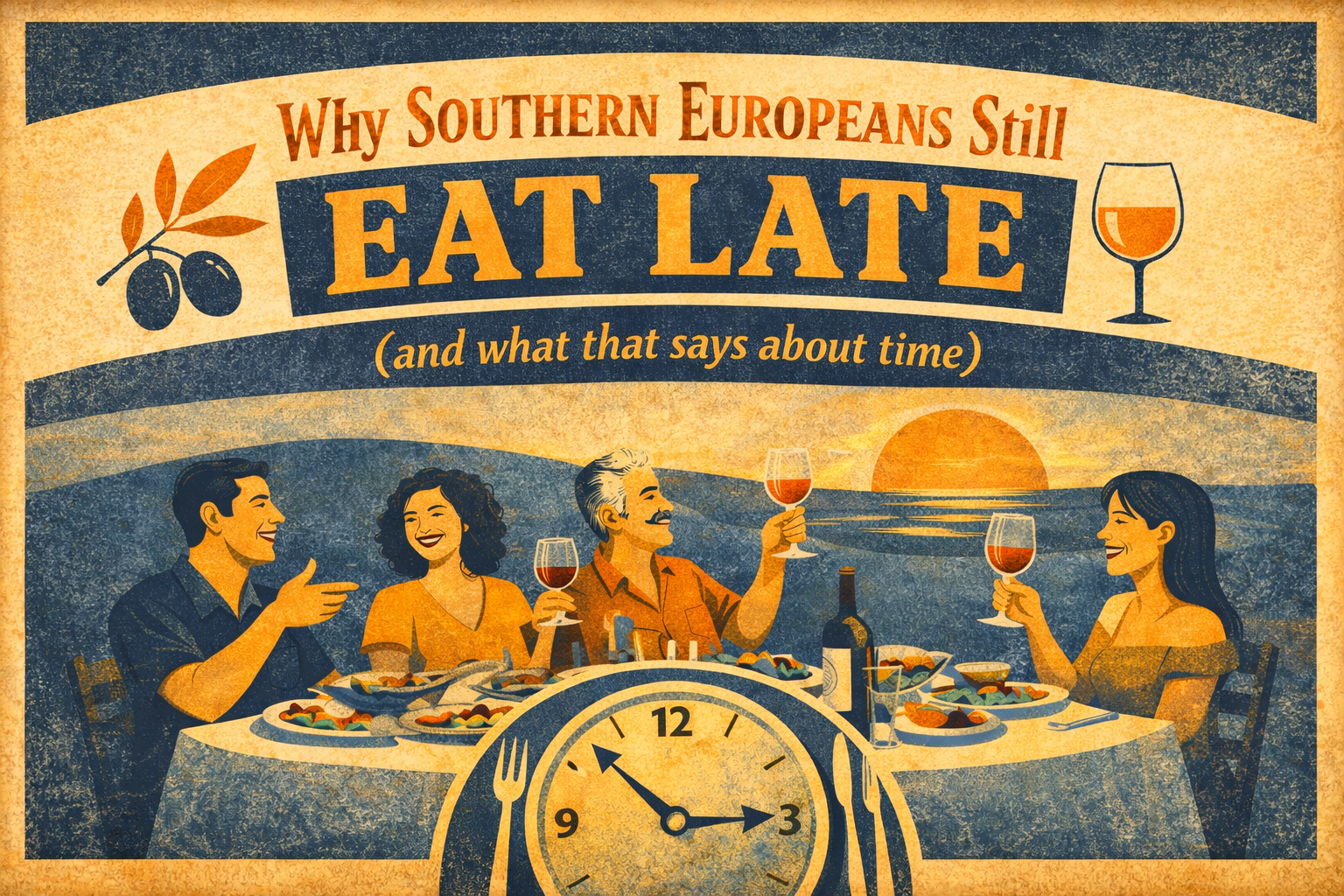
In northern Europe, dinner is a 6 pm affair: punctual, practical, and neatly concluded before the evening news. Head south, and time loosens its tie. In Madrid, restaurants open when Berliners are already in pajamas. In Naples, a 10 pm table is early. Same continent, same latitude - but utterly different clocks.
The question isn’t just when people eat, but how they experience time itself.
A Historical Hangover
The roots of late dining go deeper than heat or habit. In 1940, Spain shifted its clocks to match Germany’s, moving an hour ahead of solar time. Noon sunlight now strikes at one, lunch drifted to two, dinner to ten, and life started keeping time with the sun instead of the schedule.
That single bureaucratic act still shapes daily rhythm. Spanish primetime TV begins when others go to bed. Offices pause for long lunches. Streets hum at midnight. Portugal, which kept true solar time, eats earlier - proof that clocks can shape culture more deeply than culture admits.
Climate Logic, Social Harmony
Mediterranean heat rewrote the logic of the day. For centuries, farmers and shopkeepers adapted to the sun - resting at noon, working again when the air softened. The siesta wasn’t laziness - it was thermodynamic intelligence. As the day stretched later, dinner became a social event, not a nutritional task - an act of re-entry into community life.
Anthropologists call this the “long twilight of interaction”: those evening hours when people step outside, talk, and rejoin the rhythm of the city. In Rome or Lisbon, plazas glow long past midnight because life there is organized around sociability, not silence.
The Sociology of Time
The sociologist Edward T. Hall described the difference as monochronic versus polychronic cultures. Northern Europe runs on the first: time is linear, divided, measurable - something to “keep” or “save” and never “waste.” Southern Europe lives by the second: time is relational, overlapping, adjusted to people, not plans.
In Madrid or Palermo, you don’t “use” time - you share it. Being late isn’t disrespect; it’s flexibility toward what truly matters in the moment.
Studies indicate that southern Europeans spend about 90 minutes more per day in face-to-face interaction than their northern neighbors - yet report lower time pressure. Efficiency is not their measure of meaning; connection is.
The Quiet Defiance of Late Dinners
Even in an age of global schedules and delivery apps, the pattern holds. Food orders peak in Spain at 10:15pm, the latest in Europe. And Spaniards, despite sleeping less, report higher life satisfaction than Swedes. Eating late, then, isn’t procrastination - it’s quiet defiance against the industrial clock. Against the tyranny of time blocks, calendar alerts, and dinner at six. It’s a reminder that time, like wine, can breathe - and that “late” isn’t lazy when life is lived together.