
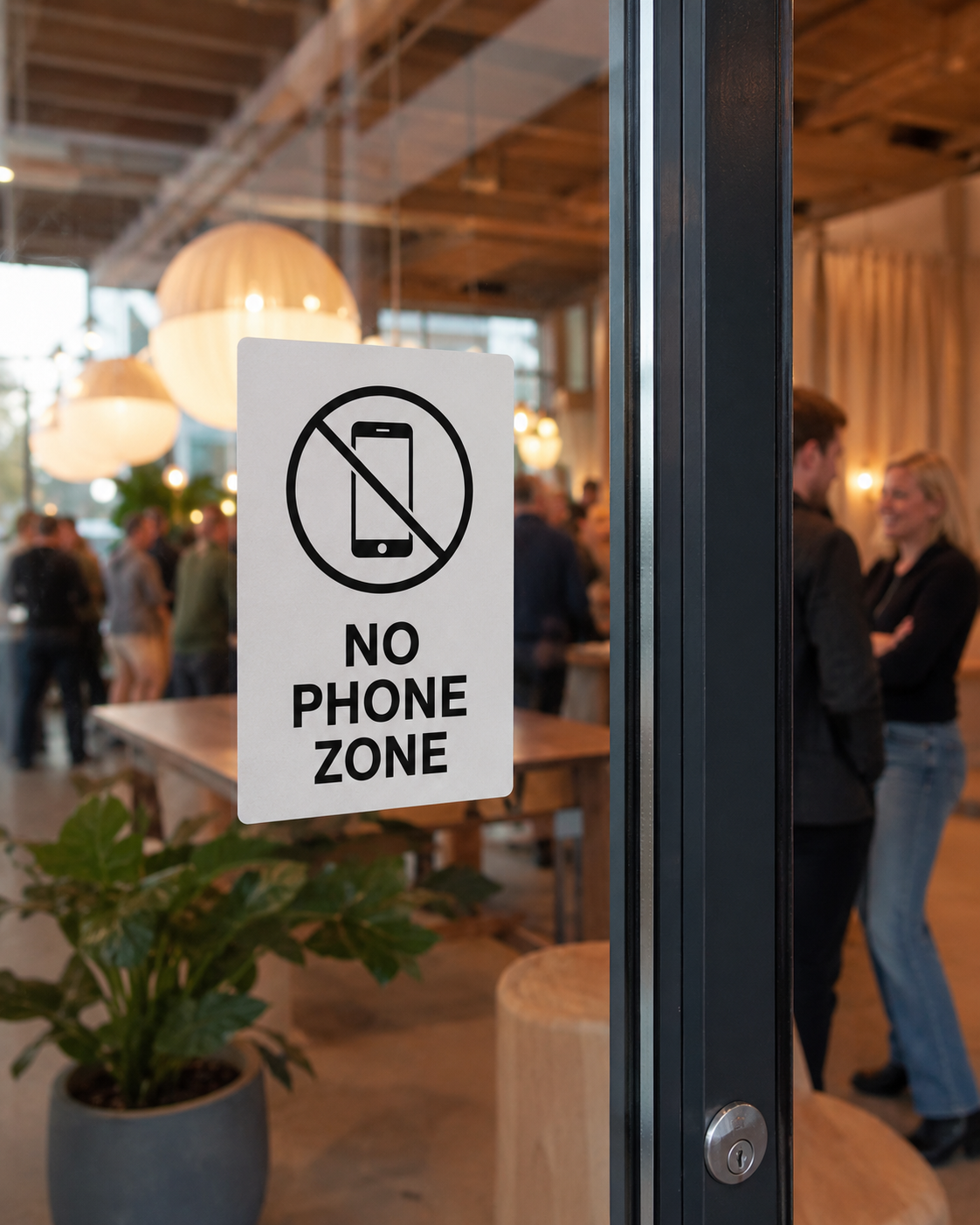
Why people are deliberately seeking out spaces without smartphones.
Around 200 people meet in the morning to do something together that, just a few years ago, was completely normal but now seems almost unimaginable: they come together to read. They read books and place their smartphones and electronic devices in a small locker before entering the reading room. A pretty bizarre idea, right? The whole thing is called a Reading Rave, and it is becoming increasingly popular.
Yes, really. According to ticketing platform Eventbrite, the number of events explicitly labelled “phone-free” on the platform rose by 567 percent worldwide between 2024 and 2025. 567 percent! The number of participants increased by 121 percent, and these events took place in 12 countries, up from just five previously.
The regional figures are even more striking:
- UK: number of phone-free events +1,200%, attendance +1,441%
- US: number of events +388%, attendance +913%
- In the first quarter of 2026 alone, phone-free events worldwide already reached more than a third of the total event volume recorded in all of 2025.
But why is that? Why don’t we simply put our smartphones away? Why do we need spaces specifically created for putting our phones away? Why do we pay to be offline for a few hours, together with other people, collectively?
Research paints a more interesting picture: we reach for our phones (too) often because our behaviour has become automatic and because the smartphone offers a quick response to boredom, stress, loneliness and social uncertainty.
The smartphone has successfully occupied the little gaps in everyday life:
Waiting for the lift? Smartphone.
Awkward silence? Smartphone.
The bus isn’t coming? Smartphone.
One particularly interesting real-life study observed 37 people for around 200 hours and analysed 1,130 individual smartphone interactions. The surprising result: 89 percent of the interactions were initiated by the users themselves. Only a small proportion were triggered directly by a notification. The researchers therefore concluded that many interruptions are based on learned routines and habits.
In the past, people waited. Looked out of the window. Watched other people. Thought. Today, there is an instantly available alternative for almost every spare minute. We swipe, check and scroll. Current research therefore already interprets excessive smartphone use, at least in part, as a form of coping behaviour. People reach for their phones to regulate stress, boredom, loneliness or unpleasant feelings in the short term.
Being available has also become a social norm
It is also interesting that a cross-country study involving around 2,000 young people in both the US and Indonesia explicitly describes permanent digital connectedness as a perceived social norm.
The researchers examined habitual and compulsive smartphone checking, deliberate “disconnect strategies” and digital stress.
The result: we don’t keep our phones with us simply because Instagram is interesting. The smartphone connects us simultaneously to family, friends, work, banking, navigation, news, tickets, calendars, music and social groups. From this, we draw the conclusion that anyone who is “offline” is missing something, is “out” and cannot keep up. The strong, often even compulsive internal pressure to respond immediately to digital messages, notifications or requests already has a name, by the way: telepressure.
A few more figures:
A Bitkom survey from this year shows that people in Germany now use their smartphones for an average of 180 minutes a day. That’s 3!! full hours! In 2024, the figure was still around 150 minutes. Among 16- to 29-year-olds, it is as much as 216 minutes a day.
Smartphones are also becoming increasingly commonplace for payments. In 2026, 67 percent of Germans had made at least one contactless payment using a smartphone or smartwatch within the previous year. Three years earlier, the figure was 51 percent.
And work increases this constant availability even further: 66 percent of working people taking a summer holiday in 2026 remain reachable for work while they are away. Of those, 53 percent say their colleagues expect this from them, while 47 percent say their managers do. At the same time, Germany’s Federal Institute for Occupational Safety and Health analysed 42 studies covering a total of 189 examined associations. Around two thirds of them were significant, with particularly frequent consequences including serious problems related to exhaustion, stress, insufficient recovery and conflicts between work and private life.
Despite all this, we are used to always being reachable.
And that is what makes switching off so much more complicated. We have to be reachable. Often, we want to be. The smartphone fills empty moments, drives away boredom and, for a moment, takes away the uncertainty that we might be missing something. At the same time, permanent availability creates a new kind of unease. Switching off has therefore become more complicated than simply turning off a device.
Phone-free events create something that is becoming increasingly difficult to establish in everyday life: a reason for being offline. For a few hours, nobody has to explain why a message remains unanswered. The rule applies to everyone. Whether people are reading, hiking, dancing, attending concerts or watching comedy shows, the smartphone simply does not matter for a limited period of time.
Perhaps that is precisely where the real appeal of these events lies. For one or two hours, nobody has to decide whether a message is important enough, whether a reply can wait or whether they are missing something. The decision has already been made. The phone stays away.
In the past, this required no event and no shared rule. Today, people meet specifically for that purpose. Perhaps that says less about our smartphones than it does about how unusual it has become to simply be offline for a few hours.