Why We Spend So Much on Flowers
Maybe they are on the dining table. Maybe on a sideboard, or by the window. It hardly matters where they are. You walk into the room, and you notice them. You admire them. You may even say something nice about them.
The object of all this attention?
Not a rare piece of art. Not a complete encyclopedia. Just a bouquet of flowers.
It is rather remarkable when you think about it. A bouquet can change a room. Any room. A dining room, a living room, a doctor’s office, a workplace. Wherever flowers appear, the room somehow feels fresher, more inviting, more cared for.
And yet we spend a surprising amount of money on something we know will wilt within days. We know exactly what will happen, and happily buy them anyway.
So where do the flowers we buy actually come from? Who gets what from a €20 bouquet?
And why do we buy flowers in the first place?
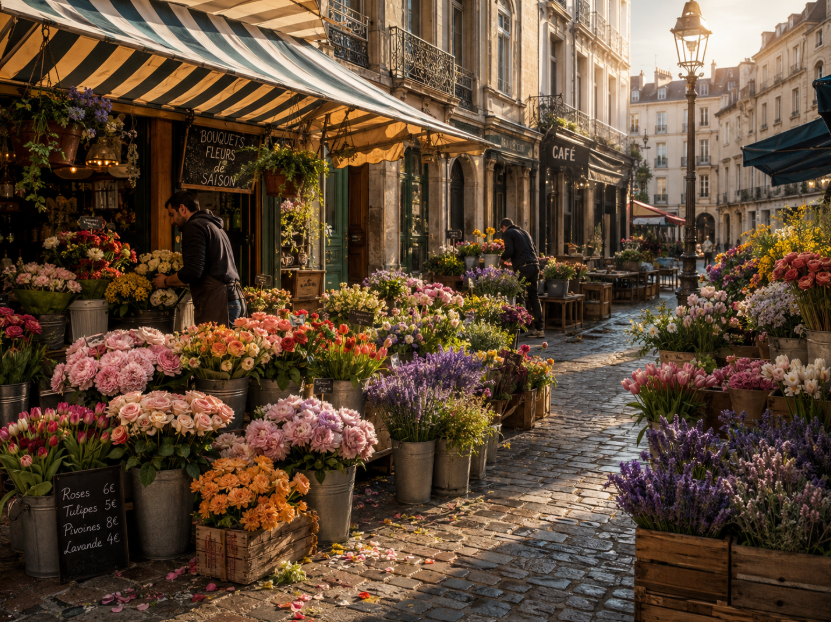
The first question is fairly easy to answer. Many of the flowers found in European homes and offices originate in Kenya, Ecuador, Colombia, and Ethiopia. In Germany, 92 percent of the flowers we import arrive from the Netherlands. “Via the Netherlands” would be more accurate, though. The country is the hub of the European flower trade, and plenty of flowers arriving from there were grown somewhere else entirely.
But what about the money?
Take a €20 bouquet. How much of that actually stays with the florist?
First, there is no precise way to trace every euro all the way back to the flower farm, because supply chains differ. Some supermarkets buy directly from growers or bouquet producers, while florists often buy through wholesalers. With a €20 bouquet from a German florist, however, we can get surprisingly close.
Fresh cut flowers in Germany are subject to the reduced VAT rate of 7 percent. From a retail price of €20, the shop is left with €18.69 in net revenue. The remaining €1.31 goes straight to the state as VAT.
Germany’s Federal Ministry of Finance publishes benchmark figures for flower and plant retailers. Since 2024, the median gross profit I has been 51 percent of revenue. Put simply, around 49 percent goes towards merchandise and materials.
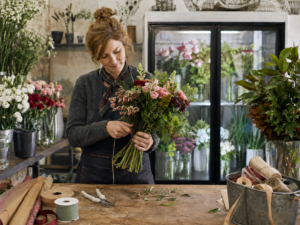
Those €9.53 are still a long way from being the florist’s actual profit. From that amount come wages, rent, refrigeration, electricity, water, packaging, cards, checkout systems, insurance, advertising, flowers that wilt before anyone buys them, and a long list of other operating expenses.
The Federal Ministry of Finance gives a median net-profit benchmark of 19 percent of economic turnover for the sector. Applied to our bouquet, that would theoretically leave around €3.55. In a 2025 interview, one florist explained that a hand-tied bouquet really needs to be priced at roughly four times the purchase price for all costs to be covered and any profit to remain. This is also why bouquets from florists tend to cost considerably more than those from discount supermarkets. A florist has the skill and arranges each bouquet individually. Competing with wholesale pricing is a different matter.
Now that we have the hard numbers, and know where the flowers come from, the central question remains:
Why do we like flowers so much?
It is a little strange, after all. We buy something we can neither eat nor use. We carry it home carefully, trim the stems, find a vase, choose a good spot and know perfectly well that only a few days later we will throw it away. And yet even a small bouquet can change the atmosphere of an entire room.
One of the best-known studies on the subject comes from psychologists at Rutgers University. The researchers wanted to know whether flowers genuinely trigger a particular emotional response, or whether we simply like them because we have learned to associate them with birthdays, weddings and other happy occasions.
In one experiment, women received either a bouquet of flowers or another gift. Among those who received flowers, researchers observed the so-called Duchenne smile particularly often. It is the kind of smile that reaches the muscles around the eyes as well as the mouth, and is used in emotion research as an indicator of genuine positive emotion.
A second experiment was perhaps even more interesting.
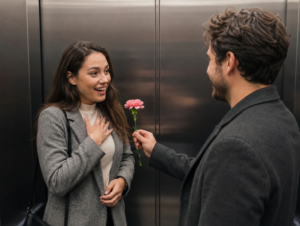
Men and women in an elevator were unexpectedly handed either a single flower or another small object. Those who received the flower smiled more often, stood closer to the person who had given it to them and were more likely to start a conversation. For a brief moment at least, the flower changed their social behaviour.
A Japanese study in 2023 also found physiological changes after people spent just four minutes looking at fresh roses. In 2020, Japanese researchers had gone a step further. They first exposed participants to psychological stress and then showed them images of flowers.
While looking at the flower images, negative emotions decreased. So did previously elevated blood pressure and the cortisol response. Functional MRI scans also showed reduced activity in the amygdala and hippocampus, areas of the brain involved in processing emotion and stress.
So at least part of the effect begins with simply seeing a flower. But why? Why does our brain react differently to a rose than to a cup, a pen or a pretty stone?
Research still has no definitive answer.
There are, however, several attempts to explain it. One begins with the flower itself. Biologically, blossoms are colourful signals. They did not evolve to decorate our homes. Their purpose is to attract bees and other animals. A flower needs to be seen. And it happens to possess several characteristics that our own visual system responds to very well.
Many flowers have clear symmetry, distinct outlines and strong colour contrasts. In a study involving more than 2,000 participants, radially symmetrical flowers with relatively low visual complexity were rated as particularly beautiful. Interestingly, shape had an even greater influence on aesthetic judgment than colour.
The human brain recognises and processes symmetry quickly. One possible explanation is what researchers call “perceptual fluency”: structures that are easy for our perceptual system to process tend to be judged more positively. Symmetry alone does not explain beauty, though. In natural landscapes, for example, perfect symmetry is certainly not what people prefer.
Flowers add something else: they combine order with irregularity.
A daisy has an obvious structure. A ring of petals, a centre, repetition. Yet no petal is exactly like the next. A rose has a recognisable structure without looking geometric or artificial.
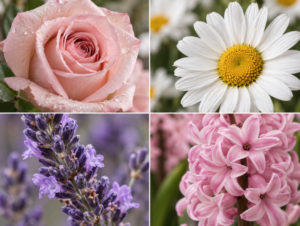
And then there is colour.
Flowers are among the few things in nature that produce such intense colour in such a small space. Red, yellow, pink, violet, blue and white stand out particularly clearly against the green of leaves.
Trees outside a window, parks, green spaces and other natural environments have been associated in numerous studies with recovery, relaxation and well-being. Anyone who lives in a city will know the pleasure of looking out over a green park. A recent meta-analysis on attention restoration did indeed find benefits for natural environments compared with non-natural ones.
Cut flowers bring a concentrated piece of that nature into our rooms.
That may matter more than it sounds. An office is made up of desks, walls, monitors, cables and paper. A doctor’s office of plastic, metal, glass and artificial light. A kitchen of cupboards and appliances.
Then someone puts a vase of peonies in the middle of it. And we react. You could almost say that a bouquet in a room works like a park in a city. A small oasis of calm and nature.
And what about scent?
Admittedly, many cultivated flowers barely smell at all anymore. Sadly. But watch what people do when someone holds out a flower to them. Very often, the first thing they do is lean in and smell it. A flower’s scent adds another layer to the positive way we experience it. Our sense of smell is also neurologically closely linked to systems involved in emotion and memory. Smells can bring back memories with remarkable immediacy. Lilac may suddenly take someone back to the garden of their childhood. A particular rose may remind us of our grandmother.
Flowers have accompanied humans for thousands of years. In Ancient Egypt, they were used as grave offerings and in religious rituals. In Ancient Greece, flowers were given as gifts. Europe later developed an entire language of flowers. In the 18th and especially the 19th century, the choice of a particular flower, its colour and even its arrangement could convey a message that perhaps could not be spoken openly.
Much of that has been forgotten. The basic idea has remained. None of us needs instructions to understand what it means to receive a bouquet of flowers.
Heather, Lily or Rose?
Perhaps our special relationship with flowers appears somewhere we rarely think about it: in our names.
Rose and Rosa, Lily and Lilly, Violet and Viola, Daisy, Jasmine or Jasmin. Flora itself comes from the word for “flower”. In English, even Heather, the flowering plant, became a popular first name. We put flowers on our tables and give them to people who matter to us. We even give their names to our children. Flower names became particularly popular as first names in the 19th century. That may seem less surprising when we consider the qualities we already associate with flowers: beauty, delicacy, colour, life, sometimes purity or love. A child called Lily, Rose or Violet is not simply named after some random object in nature. The name already carries an image and a feeling.
Flowers and Language
Someone blossoms. A young person is in the bloom of life. Something can bloom or flourish. We speak of a flourishing imagination, or of something bearing fruit. Flowers have long been more than plants. They are part of the way we talk about beauty, development, affection and life.
Science now knows surprisingly well what happens when we look at flowers. Why we find them so beautiful in the first place remains only partly understood. And perhaps the question of why we like flowers so much does not need a complete answer.
In the end, something very simple happens.
You put a bouquet of flowers on the table.
The room is still the same.
But somehow, it suddenly feels a little different.
Perhaps a little warmer. A little brighter. A little friendlier.
And we smile.