
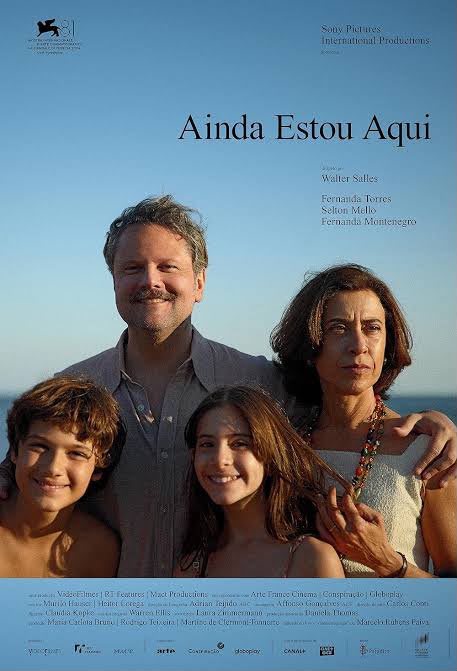
Walter Salles’ film recalls a family harmed by Brazil’s military regime and a principle every government must respect: political differences must be settled through debate, never state violence.
Nokosphere recommends I’m Still Here (Ainda Estou Aqui), the Brazilian film directed by Walter Salles and winner of the 2025 Academy Award for Best International Feature Film. Based on Marcelo Rubens Paiva’s memoir, it recounts how military repression changed one family’s life.
On January 20, 1971, former congressman Rubens Paiva was taken from his home in Rio de Janeiro by agents of Brazil’s military dictatorship. He was tortured and killed while in state custody. His remains have never been recovered. Official Brazilian investigations have documented these events.
The film follows Eunice Paiva, portrayed by Fernanda Torres, as she raises their five children and seeks answers. The harm to the family extended beyond Rubens Paiva’s death: Eunice lost her husband, the children lost their father, and the disappearance of his remains left them without answers for decades. Rebuilding family life amid that uncertainty became part of the same tragedy. The film shows how state violence can harm a family long after the immediate act.
A Regime That Violated Fundamental Rights
Brazil’s military dictatorship, which ruled from 1964 to 1985, must be condemned for the detention, torture, killings and enforced disappearances carried out under its authority. Political disagreement can never justify such acts.
In a democratic society, political opponents should confront one another through arguments, evidence, public debate and elections. Disputes over ideas belong in open discussion and lawful institutions, not in prison cells or interrogation rooms.
The state has a duty to protect the right to disagree. It must never use its power to abduct, torture or kill people who challenge those in authority.
The Universal Standard: Human Rights
This principle is not the property of any political party or ideology. It is reflected in the Universal Declaration of Human Rights, adopted and proclaimed by the United Nations General Assembly on December 10, 1948.
Article 3 protects the rights to life, liberty and security of person. Article 5 prohibits torture and cruel, inhuman or degrading treatment. Article 19 recognizes freedom of opinion and expression. These rights apply to everyone, including people whose opinions a government rejects.
A government may defend its policies, respond to criticism and enforce the law through fair procedures. It may not treat opposition as a license for violence. This standard must apply equally to governments of the left, right or center.
Truth, Accountability and the Rule of Law
In January 2025, Rubens Paiva’s death certificate was amended to recognize that his violent death was caused by the Brazilian state. Questions of criminal accountability, including the application of Brazil’s Amnesty Law to serious human rights violations, have remained before the country’s Federal Supreme Court.
Recognizing historical facts and determining individual criminal responsibility are distinct tasks. Both require reliable evidence, independent institutions and respect for due process.
Why We Recommend This Film
I’m Still Here is an important reminder that the purpose of political life is to debate how society should be governed, not to destroy those who disagree. A state worthy of public trust must protect the rights of its critics as carefully as those of its supporters.
Nokosphere condemns the abuses of Brazil’s military dictatorship and affirms the universal human rights proclaimed by the United Nations. These principles must remain above partisan disagreement.
The lesson is simple: political ideas should be answered with better ideas, never with violence. Protecting public debate is the state’s responsibility. Remembering the victims is ours.
No journalist should be silenced for exercising the right to investigate and inform the public.
Official Sources
United Nations - Universal Declaration of Human Rights (Articles 3, 5 and 19)
https://www.un.org/en/about-us/universal-declaration-of-human-rights
National Human Rights Council - Report on the Torture and Enforced Disappearance of Rubens Paiva (2024)
National Council of Justice - Rubens Paiva Death Certificate (2025)
Federal Supreme Court - Theme 1376: Amnesty Law and Serious Human Rights Violations
https://portal.stf.jus.br/jurisprudenciaRepercussao/tema.asp?num=1376
Sony Pictures Classics - Official Film Information, I'm Still Here