
Imagine it's 1995.
You leave your house, walk to a newsstand, and buy a daily newspaper. Afterwards, you meet a few friends at a café, spend a pleasant afternoon together, and then browse through a bookstore before heading home.
Sounds a lot like today, doesn't it?
Yet, aside from a handful of people you happened to encounter, no one knows where you were, what you bought, whom you met, or how long you stayed. No one knows what you talked about to your friends, what you ordered at the café, or which books you were interested in at the bookstore. You left your home unobserved, paid in cash, posted nothing on social media, and no app tracked your every move.
Today, that exact same day would leave countless digital traces. Probably more than most of us realize. And by the evening, after you've liked a few of your friends' posts, your personal algorithm would be smiling back at you, suggesting even more charming cafés nearby.
Pretty disturbing, isn’t it?
The Internet Changed Our Privacy
The internet has fundamentally transformed privacy. Some might even argue that genuine privacy no longer exists.
Much of human interaction now takes place online. Smartphones have become constant companions, and an ever-growing share of our daily lives happens in the digital world.
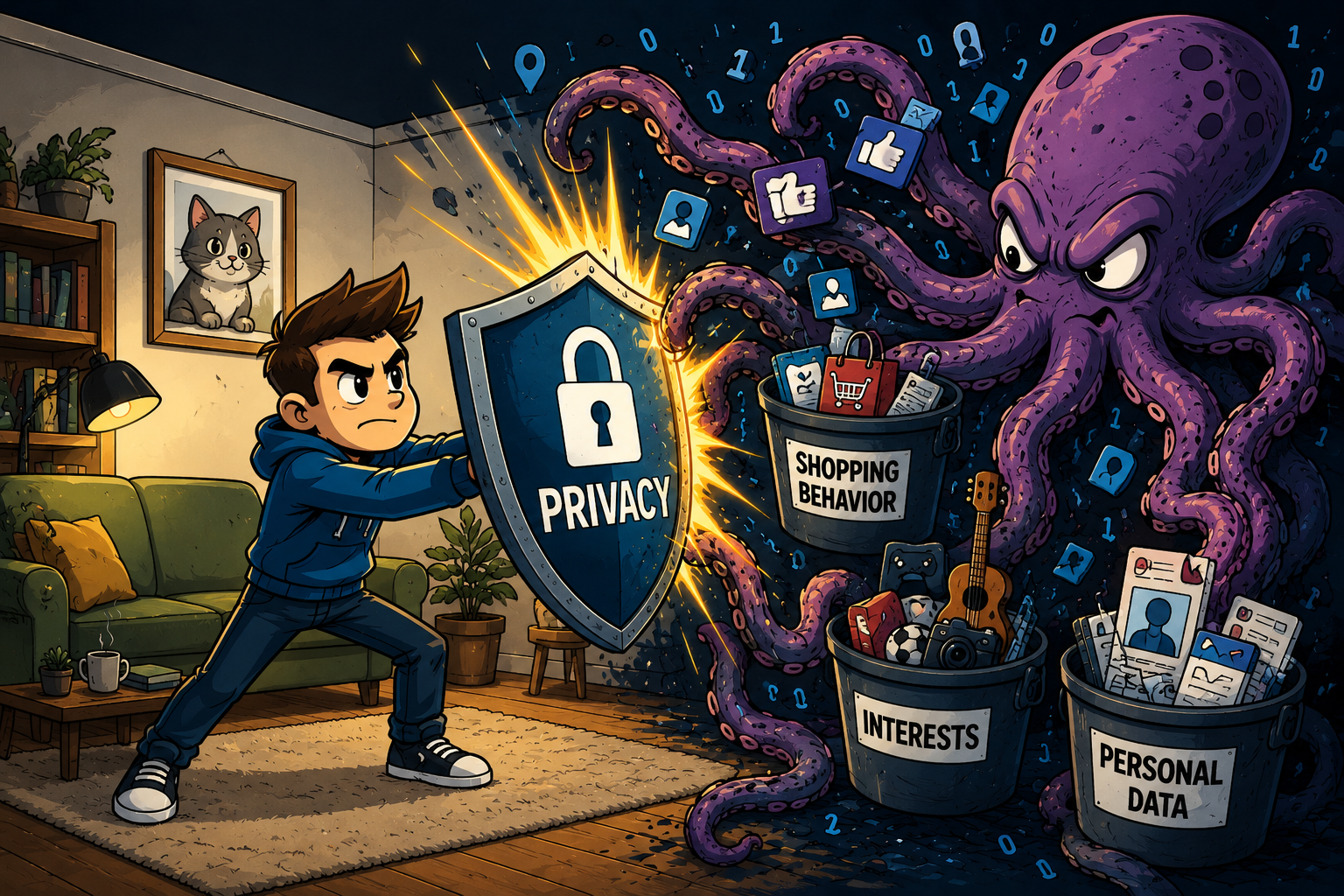
Today, social media platforms, apps, loyalty cards, search engines, smart home devices, and even our cars and washing machines continuously collect information about us. Location data, browsing habits, purchasing behavior, social interactions, and health metrics are routinely recorded, analyzed, and monetized.
Many of the services we use every day, and which seemingly make our lives easier, appear to be free. In reality, however, we almost always pay with something else: our personal data.
Most of us rarely stop to think about the data being collected. Yet our understanding of privacy has changed dramatically over the past two decades.
Many people still underestimate the power of data. The more information companies hold about us, the more accurately they can predict consumer behavior, target advertisements, influence purchasing decisions, and generate revenue. Data collection has therefore become one of the world's most valuable industries, and comprehensive personal profiles are highly traded commodities in the digital economy.
But what if we don't want that?
Can we simply stop? Can we opt out?
The honest answer is: no. And if we try, doing so often comes at a significant cost and with far-reaching consequences.
If, for example, we want to prevent our emails from being read, we need secure email providers, which often require paid subscriptions.
Privacy-focused smartphones and operating systems that prevent apps from tracking us continuously are usually far more expensive, assuming they are available at all. The same applies to VPN services, secure password managers, encrypted cloud storage, and tools designed to protect our digital identities.
In an increasingly connected and almost entirely transparent society, privacy is no longer the default condition. For many people, it has become a product, a service, and increasingly, a privilege.
And access to that privilege often depends on both financial means and individual knowledge.
How Realistic Is Opting Out?
A complete withdrawal from digital life is almost unimaginable.
Workplaces, schools, public services, banks, and health insurers are increasingly operating online. Refusing to participate in the digital ecosystem often means accepting social, professional, or economic disadvantages.
At the same time, surveillance, disguised as convenience, is moving ever deeper into our private lives.
Smart TVs, Siri, Alexa, Google Assistant, connected household appliances, fitness trackers, health apps, diet apps, and permanently connected vehicles continuously exchange data. Our data.
The home, once a private refuge, is increasingly becoming part of a digital ecosystem to which companies have permanent access.
What many people still fail to consider is that the next generation, our children, is already part of this surveillance ecosystem and begins leaving digital footprints long before taking its first steps.
Children start building digital identities before they are even born. Parents share pregnancy photos online, upload ultrasound images, and post pictures of their newborn child.
Later, they install educational apps, place smart speakers in their child’s bedroom, and connect devices that accompany their children throughout everyday life.
We know where our children are around the clock. But we are not the only ones who know. The companies profiting from our children's digital profiles know as well.
Does privacy mean hiding secrets? No.
Privacy protects our freedom to think, communicate, develop ideas, and build relationships without being constantly observed and recorded. When every action is documented, people gradually begin to change their behavior to avoid potential consequences, often without even noticing.
Privacy has not yet disappeared. But it is no longer automatic.
Increasingly, it must be defended, managed, and, in many cases, purchased. The central question may no longer be whether privacy will survive the digital age. The question may instead be who will still be able to afford it, and who will even remember what privacy once meant.
Consider the following questions:
- When was the last time you spent an entire day without generating digital data?
- Would you be willing to pay to protect your privacy?
- How much personal data are you willing to exchange for convenience?
Perhaps we should all take a moment to think about our answers.