
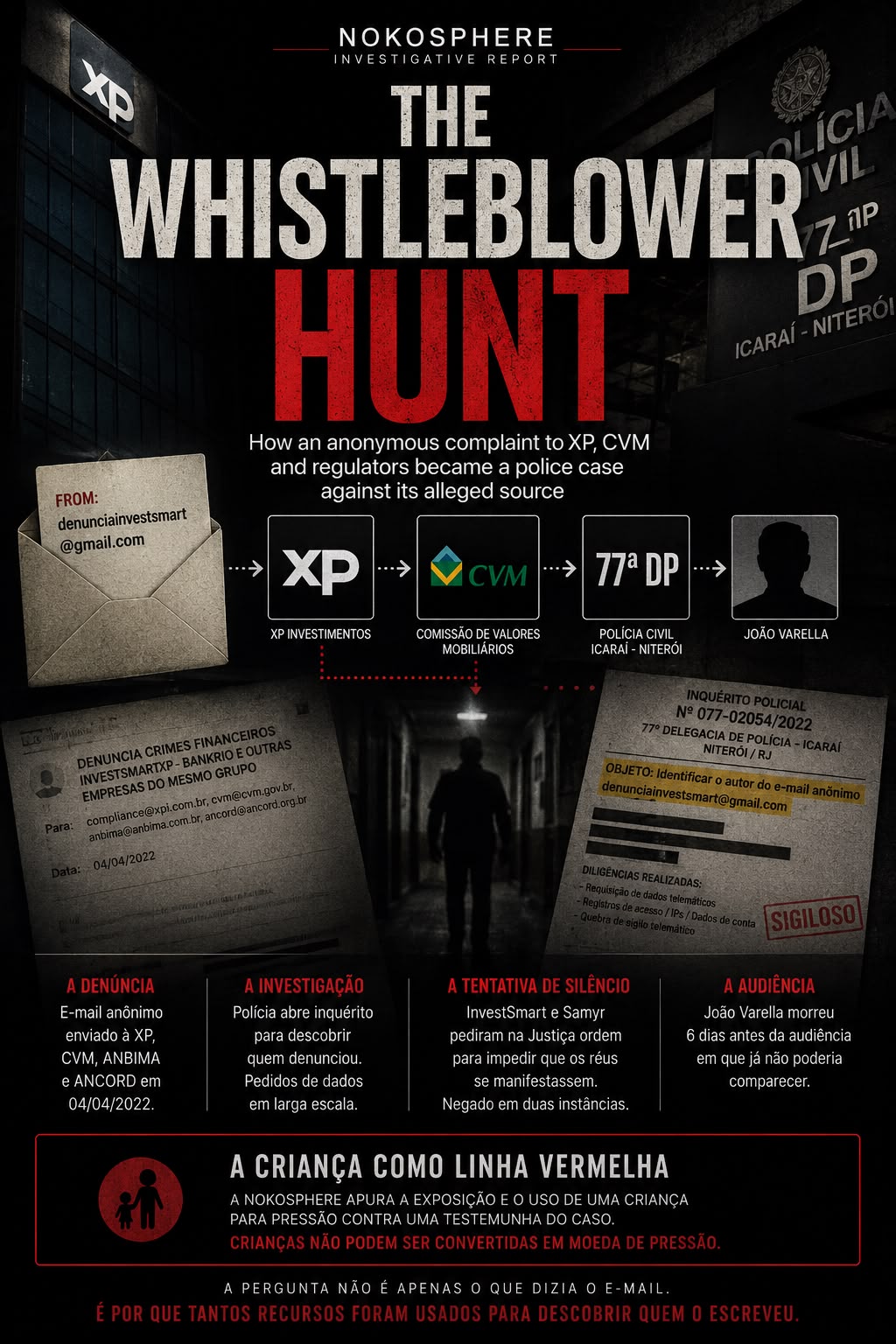
How a complaint sent to XP, CVM and regulators became a police investigation into the alleged whistleblower
The case of Joao Luiz Silva Seabra Varella reopens an uncomfortable question about Brazil's financial market: what happens when a complaint reaches powerful people?
In recent months, the Banco Master case exposed a darker side of the relationship between financial power, sensitive information and intimidation. Reports on the federal investigation stated that Daniel Vorcaro allegedly commanded an illegal intimidation and obstruction-of-justice unit; Brazil's Federal Police also pointed to monitoring and intimidation of competitors, former employees and journalists. [1]
Nokosphere does not claim that the InvestSmart case is equivalent to the Master case. The parallel is not criminal. It is institutional.
In both cases, the underlying question is the same: when sensitive information threatens financial interests, who becomes the target - the facts being reported, or the person who reported them?
In the Varella case, it began with an email.
Court documents show that Invest Smart Agentes Autonomos de Investimentos Ltda. and Samyr Teixeira Rodrigues Castro filed a civil lawsuit seeking an injunction and damages against Joao Luiz Silva Seabra Varella, Fabio Joao da Silva Soito and Beatriz Ramalho do Valle Goncalves Soito. The case was based on an anonymous complaint sent on April 4, 2022, from denunciainvestsmart@gmail.com, addressed to XP Investimentos and market regulators including CVM, Anbima and Ancord. [2]
The plaintiffs' narrative states that the email falsely imputed criminal conduct to InvestSmart partners, including Samyr, triggering audits by regulatory bodies and by XP itself. The same narrative states that the complaint generated a police report and Police Inquiry no. 077-02054/2022, through which it was allegedly possible to identify Joao Varella as the author of the email. [2]
But the central question now is not only what the email said.
The question is what happened next.
According to documents reviewed by Nokosphere, the anonymous complaint was turned into a police investigation aimed at identifying the alleged author of the message. The inquiry ran through the 77th Police Precinct, in Icarai, Niteroi.
That institutional path raises questions.
InvestSmart's operations were linked to downtown Rio de Janeiro. The complaint was sent to regulators and to a national brokerage. Even so, the police investigation went through the 77th Precinct, in Niteroi. Later, another related criminal proceeding appeared in the Special Criminal Court of Botafogo. The civil action, meanwhile, ran in the Capital.
Why this mix of venues - Niteroi, Botafogo and the Capital - in a case born from a complaint sent to financial-market regulators?
The question becomes more serious because the police-procedure documents reviewed by the reporting team identify, among those responsible for the investigation, a civil police officer who, according to documentary elements gathered by Nokosphere, had been married to Samyr Teixeira Rodrigues Castro, one of the direct interested parties in the case.
Nokosphere is preserving the officer's identity.
The reason is ethical and journalistic: years later, she appears linked to urgent protective-measure proceedings under Brazil's Maria da Penha Law, framed around psychological violence against a woman, domestic violence, and a no-contact order protecting the offended party, family members and witnesses. [6]
The purpose of this reporting is not to expose a possible victim. The point is institutional: was there a conflict of interest, vulnerability or pressure in the work of a police officer assigned to an investigation connected to her former husband?
That question should be examined by the Civil Police Internal Affairs unit and by the Public Prosecutor's Office.
The Public Prosecutor's Office has the institutional role of external control over police activity. Therefore, the question is unavoidable:
Where was the MPRJ?
The scope of the digital measures also demands a public answer.
Documents reviewed by Nokosphere indicate that the investigation sought telematic data linked to the account used for the complaint, including access logs, IP addresses, account data and other digital elements. So far, the reporting has not identified an express request for "geolocation" in the strict sense, such as GPS history or Google Location History. But the requests reviewed point to broad digital demands against the account associated with the alleged whistleblower.
For an investigation originating in alleged criminal defamation by anonymous email, the question is proportionality:
Why would a compliance complaint against a financial group justify such broad digital demands against the alleged whistleblower?
That question connects directly to XP.
XP received the complaint. The question to be answered is direct:
Did XP treat the complaint as compliance material and protect the source - or did it forward the full content to the accused, enabling the author to be identified?
The answer matters because the email did not arise in a vacuum.
CVM documents show that issues similar to those raised in the complaint later appeared in a formal regulatory proceeding, CVM Administrative Proceeding 19957.001954/2020-11, involving XP Investimentos, InvestSmart, Samyr Castro, Marcel Navarra, Bruno Hora and XP directors. The CVM opinion refers to alleged irregularities involving InvestSmart and its partners, including possible investor misdirection about the company's corporate purpose, use of the Bank Rio AAIs and BankRio Financial Group brands, and Samyr's alleged role as a "hidden partner" between 2017 and 2022. [4]
The same proceeding also addressed possible fraudulent practices, losses to capital-market clients, confusion between InvestSmart and BankRio, and a possible lack of diligence by XP in its duty to supervise the office. [4]
That is the point that changes the nature of the story.
The email was treated by the accused as false, offensive and criminal. But the CVM would later examine, in a formal proceeding, several themes that overlap with the content of that complaint.
Nokosphere does not claim that every point in the email was true.
But it does state that the complaint carried enough public relevance to deserve institutional scrutiny - not a hunt for the whistleblower.
The attempt to silence in two instances
Even before final judgment in the civil action, InvestSmart and Samyr sought to prevent Joao Varella and the other defendants from disclosing information or making statements about the plaintiffs.
In the trial court, the injunction was denied.
Then, before the Court of Appeals, the plaintiffs insisted. In the interlocutory appeal, they asked that the respondents be compelled "not to disclose or make any statement of any nature" about InvestSmart and Samyr. The TJRJ maintained the denial, stating that the documentary evidence was insufficient, that further evidentiary development was needed, and that there were no clear indications of the alleged breach of secrecy. [2]
The conclusion is clear: even without demonstrating to the court, at that stage, clear indications of the breach of secrecy they alleged, InvestSmart and Samyr attempted, in two judicial instances, to obtain an order preventing Joao Varella and the other defendants from disclosing information or making statements about the plaintiffs.
The hearing Varella could no longer attend
The chronology adds an even more uncomfortable question.
Joao Varella was identified by InvestSmart and Samyr as the person responsible for the anonymous complaint. After that, he became involved in multiple fronts: a police investigation, a civil lawsuit and a criminal proceeding in which Samyr appeared as complainant.
But there is one central detail: Varella died before a hearing in one of the proceedings brought against him.
According to records shown to the reporting team, Joao Varella died on November 7, 2023. Six days later, on November 13, 2023, a preliminary hearing was scheduled in the criminal proceeding in which Samyr appeared as complainant and Varella as defendant/respondent. The hearing did not take place because the parties were absent, according to the procedural record shown to Nokosphere. [3]
The question is objective:
Did Samyr Castro know, on November 13, 2023, that Joao Varella had died six days earlier?
If he knew, why was the court not informed before the hearing?
If he did not know, then when and how was the court formally informed of Varella’s death?
Varella could no longer appear. The question is whether Samyr knew that when he also failed to appear.
The civil case filed by InvestSmart and Samyr would later record the removal of Joao Luiz Silva Seabra Varella from the defendant list because of his death, with reference to the death certificate attached to the case file. [2]
Nokosphere does not claim a causal link between Varella's death and the litigation.
But the chronology requires scrutiny. The man identified as the author of the anonymous complaint died before he could publicly explain the origin of the email, his sources, his documents and his motivations.
Varella's death removed a central source of clarification. The journalistic question is who was no longer confronted by his version, his documents and his explanations.
The child as a red line
The series has also identified an even more serious front.
Nokosphere is investigating the exposure, monitoring and use of a child connected to a witness in the 2019 case. According to sources interviewed by the reporting team, the minor has been used as a point of pressure against her father, who holds relevant knowledge about facts later examined by the CVM. [7]
The sources say the situation has not ceased.
Nokosphere will not publish the child's name, image, routine, school, documents, medical data, family information or any detail capable of identifying the child.
The point is urgent: when a child is observed, exposed or used to reach a witness, she is no longer on the margins of the case. She becomes the red line of intimidation.
This is not a private lawsuit. It is not a dispute between adults. It is possible coercion against a witness through a child.
The Brazilian state must act.
The case requires immediate attention from the Public Prosecutor's Office, the Child Protection Council, the child-protection network and the federal bodies responsible for human rights and protection of threatened children and adolescents.
The Brazilian state cannot wait for a father's fear to become a tragedy before recognizing that a child needs protection.
Children cannot be turned into currency of pressure, surveillance or fear. The question that remains
The Varella case does not, by itself, prove a conspiracy. But it reveals a sequence that demands a public response: a complaint sent to XP, CVM and regulators was followed by a police investigation against the alleged whistleblower; that investigation passed through a precinct where the former wife of one interested party worked; the digital requests were broad; the plaintiffs tried in two judicial instances to obtain an order preventing statements by the defendants; and the alleged author of the complaint faced police, criminal and civil fronts before dying.
The question now is not only what the email said.
The question is why so many resources were used to find out who wrote it.
And to understand why an anonymous complaint provoked such a broad reaction, another question imposes itself:
Who are you, Samyr Castro?
Source notes
[1] Agência Brasil, "Vorcaro comandava núcleo de intimidação e obstrução de Justiça", Mar. 4, 2026: https://agenciabrasi l.ebc.com.br/radioagencia-nacional/justica/audio/2026-03/vorcaro-comandava-nucleo-de-intimidacao-e-obstrucao-de-just ica
[2] TJRJ case no. 0833575-55.2023.8.19.0001, complaint, decisions and procedural records reviewed by Nokosphere.
[3] Court records shown to Nokosphere regarding the criminal proceeding in which Samyr Teixeira Rodrigues Castro appeared as complainant and Joao Luiz Silva Seabra Varella as defendant/respondent.
[4] CVM Administrative Proceeding no. 19957.001954/2020-11; Settlement Committee Opinion; Collegiate Decision of May 20, 2025.
[5] CNMP, External Control of Police Activity and Resolution no. 279/2023:
https://www.cnmp.mp.br/portal/sistema-prisional/448-atuacao/10909-controle-externo-da-atividade-policial
[6] Records of urgent protective measures under Brazil's Maria da Penha Law, reviewed by Nokosphere; the potential victim's identity is preserved for ethical and safety reasons.
[7] Reports and documents received by Nokosphere regarding the child and the witness connected to the 2019 case. The child's identity is fully protected.
Further evidence:
- File 1
CVM document in Administrative Proceeding No. 19957.001954/2020-11, analyzing alleged regulatory irregularities involving XP, InvestSmart, Samyr Castro, and other respondents. - File 2
TJRJ decision upholding the denial of a request to prohibit the defendants from disclosing information about or making public statements concerning InvestSmart and Samyr Castro. - File 3
Judgment in the criminal proceedings recognizing the defendant's death and declaring the extinguishment of criminal liability. - File4
Procedural docket entry recording that the preliminary hearing scheduled for 13 November 2023 did not take place because the parties failed to appear. - Rio de Janeiro Court of Justice, Special Body Resolution No. 36/2024
- File5
TJRJ: 0058113-39.2023.8.19.0000
RECORRENTE INVEST SMART AGENTES AUTÔNOMOS DE INVESTIMENTOS LTDA
RECORRENTE SAMYR TEIXEIRA RODRIGUES CASTRO
ADVOGADO RJ135127 - GABRIEL SANT'ANNA QUINTANILHA
RECORRIDO 1 BEATRIZ RAMALHO DO VALLE GONÇALVES SOITO
RECORRIDO 2 FABIO JOÃO DA SILVA SOITO
RECORRIDO 3 JOÃO LUIZ SILVA SEABRA VARELLA - File6.1 and File6.2
TJRJ: 0058136-79.2023.8.19.0001
Interessado INVEST SMART AGENTES AUTONOMOS DE INVESTIMENTOS LTDA
Querelante SAMYR TEIXEIRA RODRIGUES CASTRO
Advogado (RJ232319) JULIANA SILVA DE MIRANDA
Advogado (RJ115624) RODRIGO BELLO
Advogado (RJ135127) GABRIEL SANT'ANNA QUINTANILHA
Advogado (RJ248854) ROGER GOMES DO MONTE
Querelado JOÃO LUIZ SILVA SEABRA VARELLA - File7
TJRJ: 0836505-46.2023.8.19.0001
INVEST SMART AGENTES AUTÔNOMOS DE INVESTIMENTOS LTDA - CNPJ: 19.438.577/0001-08 (QUERELANTE)
Ativo
JULIANA SILVA DE MIRANDA - OAB RJ232319 - CPF: 159.217.137-08 (ADVOGADO)
Ativo
ROGER GOMES DO MONTE - OAB RJ248854 - CPF: 161.792.897-60 (ADVOGADO)
Ativo
RODRIGO BELLO - OAB RJ115624 - CPF: 073.533.317-39 (ADVOGADO)
Ativo
GABRIEL SANT ANNA QUINTANILHA - OAB RJ135127 - CPF: 095.992.017-01 (ADVOGADO)
Ativo
MINISTERIO PUBLICO DO ESTADO DO RIO DE JANEIRO - CNPJ: 28.305.936/0001-40 (AUTOR)
Ministério Público do Estado do Rio de Janeiro - File8
TJRJ: 0836393-77.2023.8.19.0001
BRUNO LEONARDO SIQUEIRA DA HORA - CPF: 111.515.777-90 (QUERELANTE)
Ativo
JULIANA SILVA DE MIRANDA - OAB RJ232319 - CPF: 159.217.137-08 (ADVOGADO)
Ativo
ROGER GOMES DO MONTE - OAB RJ248854 - CPF: 161.792.897-60 (ADVOGADO)
Ativo
RODRIGO BELLO - OAB RJ115624 - CPF: 073.533.317-39 (ADVOGADO)
Ativo
GABRIEL SANT ANNA QUINTANILHA - OAB RJ135127 - CPF: 095.992.017-01 (ADVOGADO) - File9
TJRJ: 0809720-44.2023.8.19.0002
MARCEL NAVARRA DE ANDRADE - CPF: 100.764.917-81 (QUERELANTE)
Ativo
JULIANA SILVA DE MIRANDA - OAB RJ232319 - CPF: 159.217.137-08 (ADVOGADO)
Ativo
ROGER GOMES DO MONTE - OAB RJ248854 - CPF: 161.792.897-60 (ADVOGADO)
Ativo
RODRIGO BELLO - OAB RJ115624 - CPF: 073.533.317-39 (ADVOGADO)
Ativo
GABRIEL SANT ANNA QUINTANILHA - OAB RJ135127 - CPF: 095.992.017-01 (ADVOGADO)
Ativo
MINISTERIO PUBLICO DO ESTADO DO RIO DE JANEIRO - CNPJ: 28.305.936/0001-40 (AUTOR)
Ministério Público do Estado do Rio de Janeiro
Ativo - File10
TJRJ: 0809618-22.2023.8.19.0002Participante
Situação
SAMYR TEIXEIRA RODRIGUES CASTRO - CPF: 098.468.877-36 (QUERELANTE)
Ativo
ROGER GOMES DO MONTE - OAB RJ248854 - CPF: 161.792.897-60 (ADVOGADO)
Ativo
JULIANA SILVA DE MIRANDA - OAB RJ232319 - CPF: 159.217.137-08 (ADVOGADO)
Ativo
RODRIGO BELLO - OAB RJ115624 - CPF: 073.533.317-39 (ADVOGADO)
Ativo
GABRIEL SANT ANNA QUINTANILHA - OAB RJ135127 - CPF: 095.992.017-01 (ADVOGADO)
Ativo
MINISTERIO PUBLICO DO ESTADO DO RIO DE JANEIRO - CNPJ: 28.305.936/0001-40 (AUTOR)
Ministério Público do Estado do Rio de Janeiro
Ativo
- File 1
Editorial and Public Interest Notice. Presumption of Innocence, Human Rights, and the Protection of Vulnerable Persons
In this report, Nokosphere does not accuse the Civil Police of the State of Rio de Janeiro, the 77th Police Precinct (77ª DP), its officers, the Public Prosecutor's Office, XP Investimentos, InvestSmart, or any other individual mentioned of committing a crime, acting with intent, bad faith, or engaging in any unlawful conduct. The report presents reviewed documentary evidence, a chronological account of events, public records, source testimony, and objective matters of public interest concerning potential conflicts of interest, the proportionality of digital investigative measures, the protection of whistleblowers, external oversight of police activity, and the protection of vulnerable persons.
The issues raised are journalistic, institutional, and of public interest. They are not definitive findings of criminal wrongdoing. All individuals and institutions mentioned are entitled to the presumption of innocence, the right to be heard, the right to a full defense, the opportunity to respond, and the opportunity to submit documents or other clarifications.
This report is guided by a commitment to freedom of the press, the protection of sources, the defense of human rights, due process of law, the protection of whistleblowers, the safeguarding of children and adolescents, and the safety of witnesses, potential victims, and persons in vulnerable situations.
Journalism in the public interest has a duty to shed light on situations in which vulnerable persons may be at risk, witnesses may be under pressure, sensitive data may be vulnerable to misuse, and the exercise of state power requires oversight, transparency, and accountability.
For that reason, Nokosphere protects sensitive identities, does not disclose unnecessary personal information, does not publish confidential documents in full, does not identify children, potential victims, protected witnesses, or other vulnerable third parties, and avoids publishing any information that could increase personal, family, or institutional risk.
Nokosphere remains open to responses and to the right of reply from all institutions and individuals mentioned. Relevant statements, documented clarifications, or factual corrections will be carefully reviewed and incorporated with appropriate prominence.