
Recently, I was sitting with friends, talking over pizza and wine about developments in world politics, when someone said something that stayed with me:
"These days, countries don't just conquer and annex other countries anymore. That happened in the past. Not today."
It's true. Today we have international law, the United Nations, and democracy. We believe we have reached a stable geopolitical order. We have laws, institutions, and security. The wild, unpredictable chapter of human history is behind us. We live in what comes after.
But do we really?
Have we truly arrived?
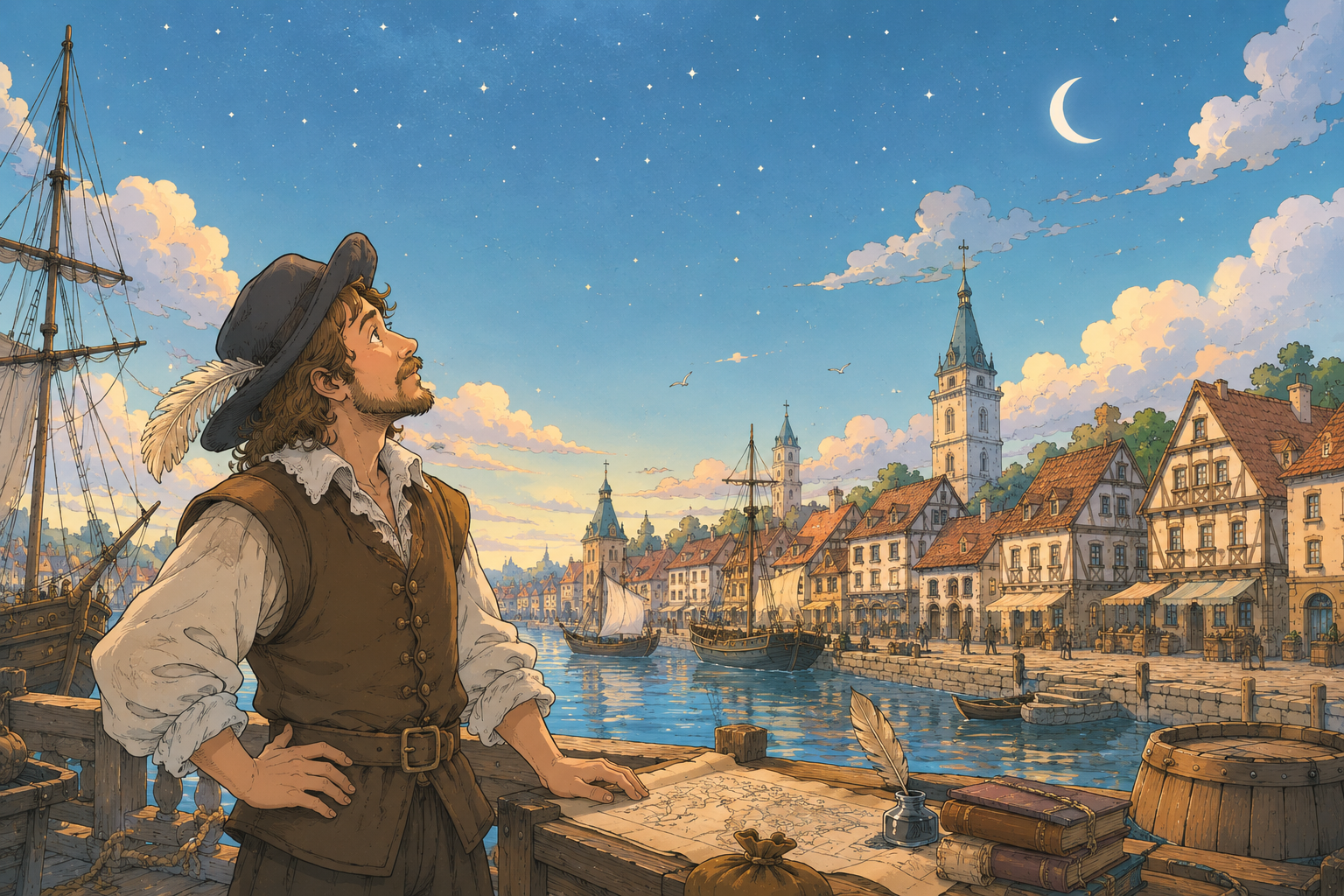
What about a merchant in the seventeenth century? Wouldn't he have thought exactly the same? Didn't he also believe he was living in a permanent and secure order under the eternal authority of the king? Yet only a few generations later, great revolutions swept across Europe, and the Enlightenment shattered that sense of permanence forever.
And what about a Roman merchant? In the year 362, did he have any idea that the seemingly invincible legions would collapse and invaders would one day march through the streets of Rome? Did he imagine that the empire itself would dissolve? Did he even think such a thing was possible?
Almost certainly not. The Roman Empire was eternity itself. Yet today it no longer exists.
The belief in permanence is every era's greatest illusion.
We always experience history through the rearview mirror, never through the windshield. When we are living through an era, everything feels stable, logical, and enduring. A merchant standing in a marketplace in 1633 smelled the smoke of distant battles from the Thirty Years' War and prayed even more fervently to God because he was convinced that, in the end, divine order would prevail. To him, feudalism was not a temporary system. It was the foundation of the world. Today, we believe in democracy.
The illusion runs deeper than you might think.
Take medicine: Modern medicine allows us to save people who would have died from their illnesses only a few decades ago. We have decoded parts of genetics, understand cells, viruses, and bacteria, and can even transplant beating hearts.
Yet if we look back at that seventeenth-century merchant, he trusted the medicine of his own time just as completely. He knew that the human body contained four humors that had to remain in balance to preserve health. And if he developed a fever, he would visit a learned physician, who would open a vein to drain the excess blood.
That merchant did not feel primitive. Nor did he think there was still an enormous amount left to discover. He trusted the unquestionable knowledge of his age. He felt that humanity had arrived. He probably even considered himself progressive. When he had his blood drawn, he experienced exactly the same certainty that we feel today when we go to see a doctor.
Our view of the stars has changed as well.
When we look up at the night sky, we see stars and know they are millions of light-years away. We learned about the Big Bang in school, about the Theory of Relativity, and about the Earth as nothing more than a tiny pale blue dot in an unimaginably vast, expanding universe. We know the Earth orbits the Sun, and the Moon orbits the Earth. We believe we have uncovered the fundamental laws of nature, leaving only the finer details to be refined in our major research institutions.
And the merchant of the seventeenth century? He knows nothing of the Big Bang.
When he looks into the night sky, he sees the solid, protective ceiling of God's heavenly palace. The stars are diamonds fastened to crystal spheres that revolve around his motionless world, carried by angels.
The Roman of the year 362 also looks up and sees the same glittering stars. But in his universe, no Christian angels travel across the heavens. The gods themselves are there. Jupiter. Mars. And, of course, the radiant, unconquered Sun. They move in perfect paths around Rome, the eternal center of the world.
But don't we know better? We do.
Today, we have history books. We can easily trace the enormous transformations of the past. Our brains are remarkably efficient, but in order to keep us functioning, they rely on fundamental psychological mechanisms that create the illusion of permanence.
One of them is the status quo bias, a deeply rooted tendency to see the present state of the world as normal. From an evolutionary perspective, our minds naturally treat current conditions as the stable and logical baseline for the future. Radical disruptions, systemic collapse, and sudden crises are mentally pushed aside because living in a constant state of perceived instability would be psychologically overwhelming.
We are also constantly affected by projection bias. We have a cognitive tendency to project our current emotions, moral values, and social priorities into the future, as though the entire framework around us will never fundamentally change. Because we regard democracy and human rights as the highest ideals today, we instinctively assume that people three hundred years from now will see the world exactly the same way.
We can hardly imagine otherwise.
Then there is the End of History Illusion, a concept introduced through the influential psychological research of Jordi Quoidbach, Daniel Gilbert, and Timothy Wilson. It describes our deeply rooted psychological inability to accept that our own world will change just as radically in the future as it already has in the past.
So when we gather today, comfortably seated with friends over pizza and wine, confidently declaring, "Countries no longer conquer each other. We cure diseases in laboratories. We are advanced now," we are doing exactly what the merchant of 1633 did.
Exactly what the Roman of 362 did.
History is not a completed project that happened to be finished during our lifetime. It keeps moving.
Day after day.
Decade after decade.
Era after era.
A few centuries from now, people will gather around tables. Or perhaps they will stand, or fly. They will drink wine, or something that we cannot even imagine today. They will talk about our medicine, our democracies, and our supposedly permanent borders.
And they will shake their heads, smile wearily, and take comfort in the belief that they, at last, are living in a truly advanced age.