Seeking Freedom, Finding Verification...
Elon Musk’s takeover of the platform formerly known as Twitter has reshaped the world of microblogging. Companies, politicians, celebrities, and private users have turned their backs on the platform, now called X, and have since been wandering through the digital landscape searching for a new home. Some have settled on Mastodon or other Fediverse services, while others have migrated to Bluesky.
That may now be about to change.
On Wednesday, “W” officially launched.
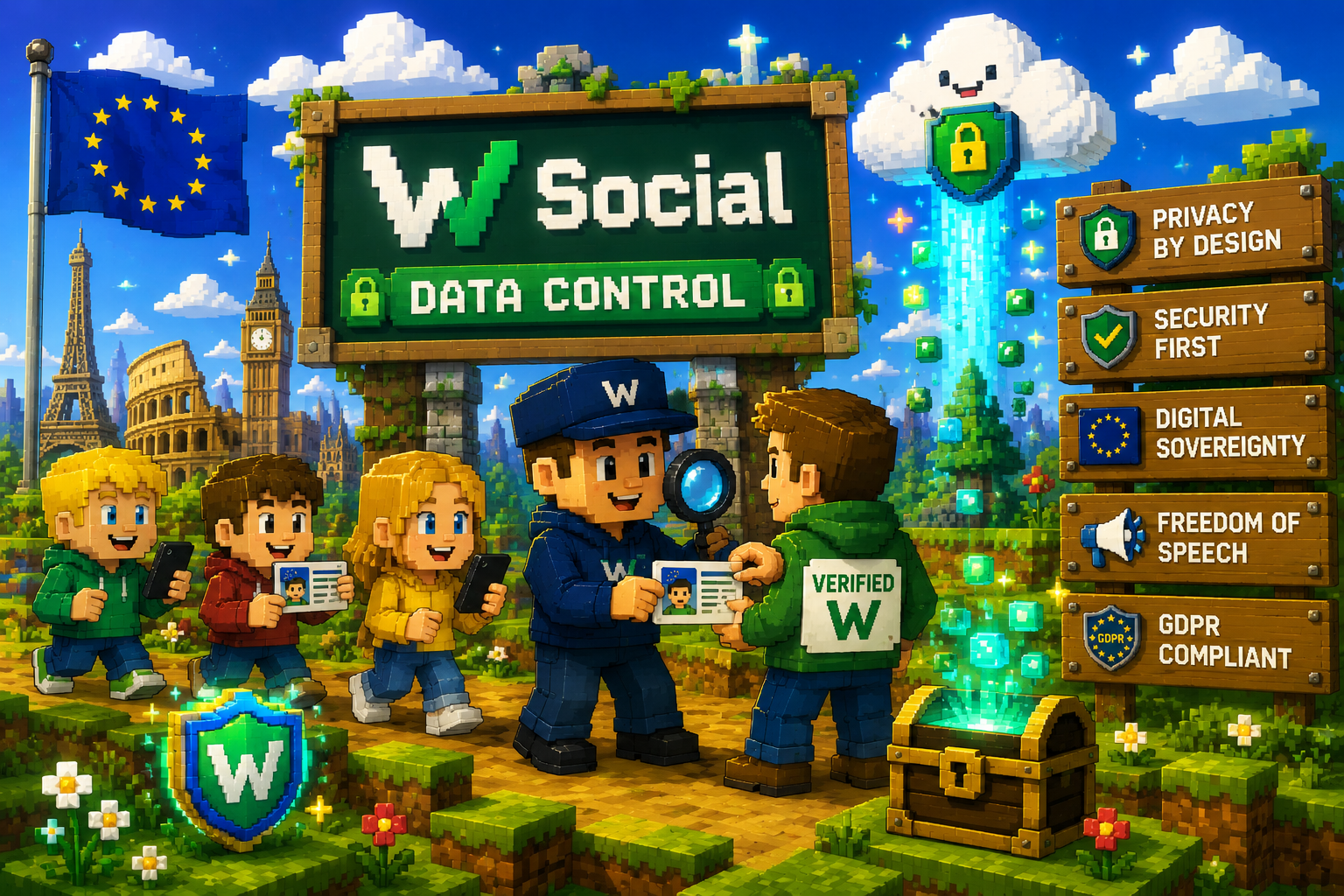
“W Social,” pronounced “double-u Social,” aims to become Europe’s answer to X and strengthen the continent’s independence from US tech giants. According to German public broadcaster WDR, users from 180 countries had already expressed interest in the platform before launch, and more than 50,000 people had registered in advance. The promise: greater privacy, servers located on European soil, and increased digital sovereignty.
The project was originally scheduled to launch in 2027. However, after Elon Musk expressed frustration in December 2025 over a fine related to violations of the Digital Services Act and posted, “I want to eliminate the European Union,” founder Anne Zeiter and her team accelerated their plans. They wanted to move faster. Faster than 2027. According to Zeiter, additional team members were brought on board, making the mid-2026 launch possible.
What Is the Digital Services Act?
Since 2024, the Digital Services Act (DSA) has defined the responsibilities of online platforms, social networks, marketplaces, and search engines toward their users within the European Union. Its stated objective is to make the internet more transparent and safer.
Among its key requirements is the obligation to review and, where appropriate, remove illegal content more quickly after it has been reported. What qualifies as illegal is determined by the laws of individual member states and by court decisions. Platforms must comply with these legal requirements while also enforcing their own terms of service.
Critics argue that the DSA gives the European Union excessive indirect influence over public debate and that social media platforms may remove too much content out of fear of substantial fines, thereby restricting freedom of expression. Supporters counter that social networks have acquired a societal role comparable to that of traditional mass media and therefore require stronger regulation.
According to Zeiter, investors in the W project include entrepreneurs from Sweden and Norway, while the platform’s servers are provided by a Finnish company. Development work is now also taking place in Berlin and Paris.The founder dismisses rumors that W Social is receiving €500 million in EU funding as “disinformation.” Instead, the platform is expected to generate revenue through advertising, naturally in compliance with GDPR regulations, as well as through the sale of individual articles.
In a podcast interview, Zeiter said she envisions W becoming the first platform Europeans open each morning to get informed. Information, however, viewed through a European lens rather than an American, Chinese, or other international perspective.
Technically, the network is built on the same AT Protocol used by Bluesky. This allows users to communicate with Bluesky’s roughly 40 million users from day one, rather than starting from scratch.
Unlike Bluesky, however, W requires users to verify their identity using an official ID document during registration. The goal is to ensure that every account belongs to a real person rather than a bot.
“We want to verify users as human beings because we feel that this is actually the biggest weakness of the major players in the US. You often no longer know whether you're chatting with an AI bot or a human being. And when it comes to AI bots, you don't know where opinion manipulation is coming from or who may be influencing it,” Zeiter explained.
According to the company, personal data submitted during registration will not be stored. As of June 17, 2026, however, Nokosphere was unable to find answers regarding the creation of multiple accounts using a single ID or the possibility of registering with someone else’s identification document.
Despite the ID requirement, users will not be required to publish their real names. W will, however, probably display information such as a user’s location, nationality, and age range.
Zeiter describes the concept as follows: “We know that there is a real person behind the account. They may choose to appear anonymously under a name like MickeyMaus123, but people will know: this person is between 40 and 50 years old, is German, and lives in Switzerland.”
Whether privacy-conscious Europeans will embrace this approach remains to be seen in the months ahead.
The platform’s name, “W Social,” stands for “we” while also representing two of its core values: “Values” and “Verified.” According to Zeiter, the fact that the letter W comes directly before X in the alphabet is no coincidence either.
User reactions to W have been mixed. While some welcome the platform because they feel safer online, others have expressed concerns.
One issue is that W is currently available only in English. There is no option to switch languages at this stage. This has surprised some users, given that the platform presents itself as a European alternative and the European Union has 24 official languages. Comments published on WDR’s website suggest that for many users, this alone is a deal-breaker.
Another legitimate question concerns the platform’s identity verification requirements. If Bluesky users do not need to provide ID documents, why is such verification mandatory for W, even though both platforms operate on the same protocol and their users can interact with one another?
W Social has entered the market with the ambition of increasing Europe’s digital independence. Whether mandatory identity verification and the disclosure of certain personal characteristics are the right path toward that goal is a question likely to divide opinion for a long time to come