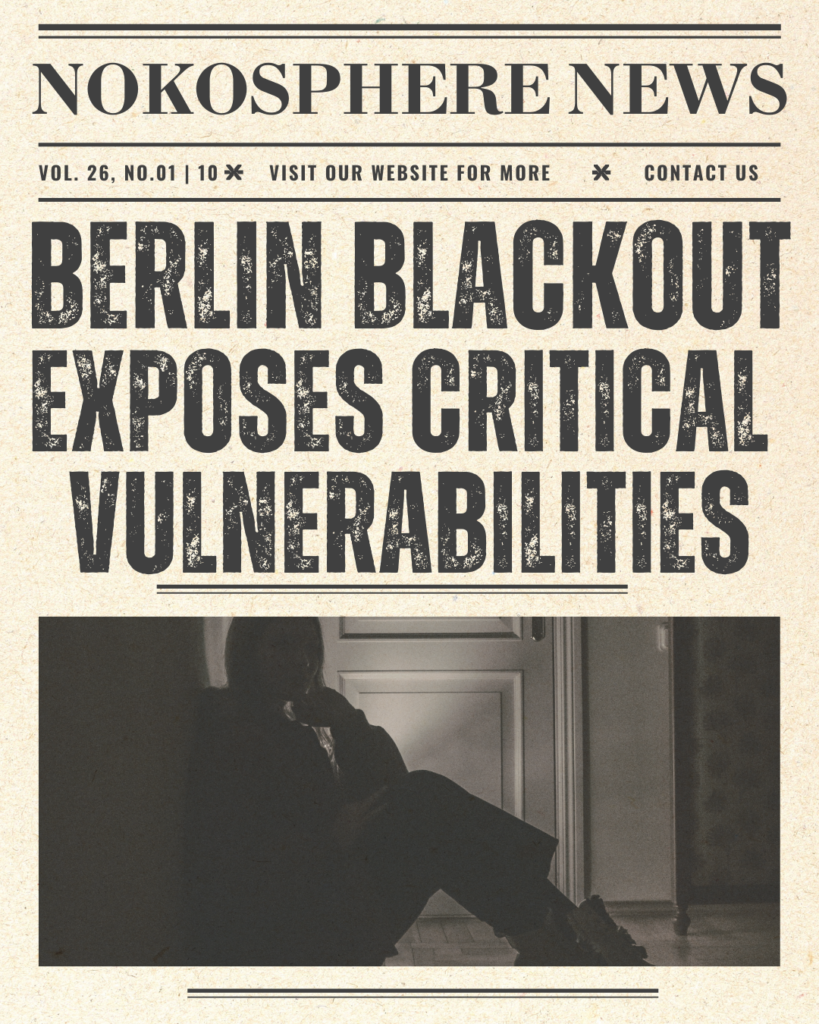
The power outage that affected large parts of Berlin’s southwest in early January was, according to investigators, caused by a targeted arson attack carried out by the left-wing extremist “Vulkangruppe.” According to assessments by the Federal Office for the Protection of the Constitution, the group has carried out a total of 13 attacks on infrastructure facilities in Berlin and Brandenburg since 2011. The group was also responsible for the attack on the Tesla plant in Brandenburg.
The blackout struck Berlin at its core:
45,000 households and 2,200 businesses were left without electricity.
Around 100,000 people sat in the dark for five days.
No power. No heating. And this in the capital of Germany.
Of course, residents were evacuated. Of course, the Federal Agency for Technical Relief (THW) drove through the streets. Of course, there was assistance. But was it enough? No.
There are reports of several burglaries and at least one death connected to the power outage. Media coverage of these incidents, however, has been limited.
Beyond the obvious weaknesses in the protection of critical infrastructure, the event exposed a second vulnerability - one that does not lie in cables or substations, but in political leadership.
From the outset, authorities classified the fire at a cable bridge near the Teltow Canal as targeted sabotage. Naturally, the mayor immediately canceled all private activities, rushed to his office, and took charge of the city’s security situation, for which he is responsible…
No. He did not.
According to multiple media reports, Kai Wegener did not initially interrupt private appointments, including leisure activities (like tennis), during the early phase of the crisis. Political observers noted that the realization that the city was facing a serious security situation came only later.
This perception is decisive. And telling. In a city where trust in state institutions is already strained, the impression of delayed political urgency further fueled public frustration. Traffic lights failed, rail services were disrupted, emergency services operated under increased strain - while clear political signals lagged behind the situation.
Ultimately, the blackout exposed two interconnected vulnerabilities. The first is structural: a power grid with insufficient redundancy, in which a single attack can paralyze entire districts. The second is institutional: crisis leadership that reacts too slowly at a critical moment to convey determination, presence, and control - not to mention protection for the population.
How well is Germany prepared for crisis situations in general?
Beyond the usual advice along the lines of “you should have a camping stove at home” (translated: help yourselves, we cannot), public broadcaster reporting states (Tagesschau, Days-Long Blackout in Berlin – What to Do When the Power Goes Out?, as of 08 January 2026, 4:13 p.m.):
According to a survey in which 411 cities and districts participated, around 80 percent stated that they have no emergency response plan at all for a power outage. Fourteen percent have no disaster protection information points that would be operational within a few hours. And 47 percent - nearly half - reported having no operational concepts at all for emergency water supply.
This is something we should think about.