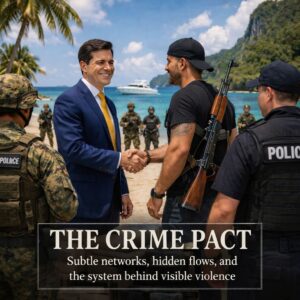
Weapons, drugs, illicit financial flows, and social complacency demand scrutiny far beyond the violence visible in the streets
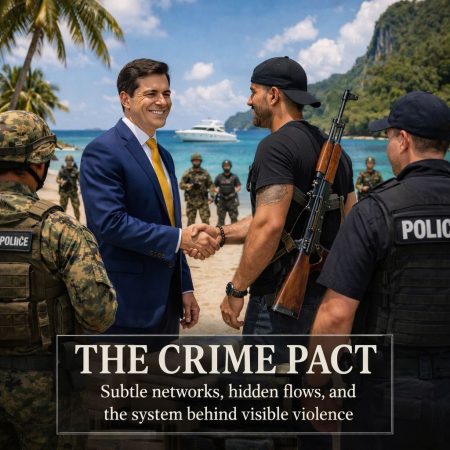
In societies marked by persistent violence, one of the most common simplifications is to treat organized crime as though it were limited to the brutal act committed at the end of the chain. As ifthe criminal apparatus began and ended with the armed man on the corner, street-level drug dealing, localized confrontation, or territory already burdened by stigma. That reading, although common in public debate, falls short of capturing the problem’s real complexity.
Cocaine does not emerge spontaneously. Nor do weapons designed for restricted use, or with high offensive capacity. Both presuppose routes, crossings, failures or insufficiencies in inspection, logistical networks, material facilitation, and financial circulation. When weapons and drugs reach major urban centers with consistency, the question can no longer be limited to who sells or who fires. The broader question is different: what conditions allow this circulation, who benefits from it, and why the mechanisms meant to contain it so often prove insufficient.
It is precisely here that public debate tends to become impoverished. The visible perpetrator of violence is often the most exposed and most replaceable part of a much larger chain. At the base are the vulnerable, the recruitable, the disposable. Above them, more sophisticated structures may operate – structures of supply, distribution, asset concealment, money laundering, and informal economic protection.
When looked at more closely, organized crime reveals itself less as pure disorder and more as method. It depends on supply, financing, distribution, and the reinsertion of capital. That means its analysis cannot remain confined to the police scene. It must also reach the circuits through which money passes, is hidden, is reconfigured, and, at times, attempts to acquire an appearance of legitimacy.
It is on this ground that the discussion of money laundering ceases to be peripheral and becomes central. Whenever resources of illicit origin find channels for concealment, movement, and reuse, the problem ceases to be merely criminal in the immediate sense and also takes on an economic, institutional, and strategic dimension. The visible violence at the end of the chain often depends on less apparent intermediations.
Against that backdrop, a sensitive question emerges: the possibility that financial operators willing to facilitate illicit flows tied to certain criminal economies may, in theory, offer similar services to other transnational illicit networks. Framing that possibility with caution is more prudent than turning it into a slogan. Ignoring it altogether, however, also seems incompatible with a serious examination of the contemporary dynamics of organized criminality.
This is not about automatically conflating distinct categories, nor about equating complex phenomena without sufficient empirical basis. Narcotrafficking, illicit financing, and terrorism are not synonyms and should not be treated simplistically. Still, it is legitimate to acknowledge that transnational illicit structures may share methods, intermediaries, routes, logistical operators, and financial instruments. That possibility alone already calls for rigorous scrutiny.
That observation demands caution, but also analytical clarity. The problem does not lie only in the illicit goods that cross borders, but also in the human, logistical, and financial infrastructure that makes their circulation possible. In environments of low transparency, fragmented enforcement, or insufficient institutional capacity, clandestine activity may find room to operate with resilience.
There is also another point that should not be ignored: the hypocrisy of socially protected sectors in the face of the violence they claim to condemn. Crime does not produce effects only at the margins. It also interacts, directly or indirectly, with environments of consumption, social shielding, moral indifference, and selective convenience. Recognizing this does not require irresponsible generalizations; it requires intellectual honesty. Part of this picture is also sustained by a persistent double standard: public condemnation is directed at the overt violence of the streets,
while the patterns of consumption, tolerance, and social distance that help normalize its effects are spared the same degree of scrutiny. When the illicit is treated only as a problem of ‚the other side,‘ a comforting fiction is preserved – one that is socially useful for those who prefer to remain outside the field of analysis.
But the violence that erupts on the surface may previously have traveled through far less visible paths: fragile borders, failures of control, facilitation networks, mechanisms of financial concealment, and environments that consume, profit, remain silent, or simply choose not to ask questions.
For that reason, the decisive question is not merely who appears on the visible front line of criminality. The more uncomfortable – and perhaps more necessary – question is another: whatstructures sustain the ecosystem of crime when the cameras are not filming? Which channels allow continuity? Which circuits absorb value? Which zones of opacity make the system more resilient than it appears?
Serious journalism does not have a duty to offer categorical answers where individualized proof is absent. But it does have a duty to formulate the right questions, to keep scrutiny alive, and to reject the simplistic narrative according to which crime is born alone, organizes itself alone, and feeds itself alone.
It is not born alone.
It does not organize itself alone.
It does not sustain itself alone.
It depends on permissiveness, circulation, opacity, and money.
The landscape may remain beautiful, storefronts may remain intact, and official discourse may continue to insist on the surface. None of that alters the central point: organized violence is sustained not only by weapons and brutality, but also by financial flows, failures of containment, facilitation networks, and zones of moral comfort.
And every time a society avoids asking who moves the money, who transports, who supplies, who protects, who consumes, and who profits, the problem remains larger than the simplified version people choose to tell.