Every day, we read articles, listen to interviews and podcasts, and scroll through social media. Yet what most of us fail to notice is this: what we read and hear shapes the way we think as a whole – because words have power. More power than most of us realize.
Words shape our reality. And they don’t need insults, slurs, or direct threats to do so. The way something is named already determines how we think about it – and how we feel about it.
Words decide how we see things, and they also decide what we pay attention to in the first place. What is named moves to the foreground. What is not named remains invisible – and is often forgotten.
This dynamic can be observed in many areas, from political debates to private communication.
A small example:
How do you feel when reading this sentence?
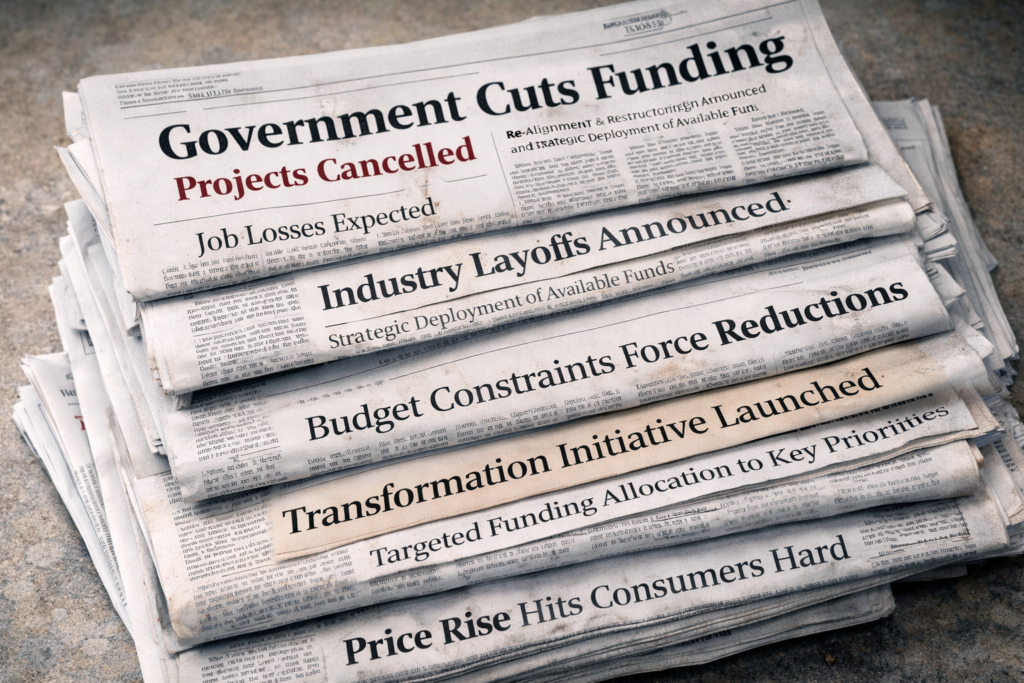
“The government has cut funding, meaning fewer projects can be implemented and some planned initiatives will be cancelled.”
The sentence conveys a clearly negative – perhaps even alarming – message. The word “cut” signals the reduction of something that already existed – a clear limitation. The word “cancelled” suggests that real plans will no longer be carried out, pointing to missed opportunities and unrealized intentions.
The sentence therefore does not merely describe a decision – it highlights its consequences: fewer possibilities, less implementation, less future.
Now let’s try another sentence:
“The government has restructured its funding programs to allocate available resources more efficiently.”
How does that sound?
Probably much more positive than the first one, right?
That is because our perception feels comfortable with notions of future orientation, purpose, and control. Terms like “restructured,” “available resources,” and “efficient allocation” evoke structure, direction, and stability.
What is striking, however, is what this sentence does not say:
That projects will be cut.
That planned initiatives will not be implemented.
That people, as a consequence, may worry about their jobs and livelihoods.
So what just happened?
The power of words has shifted perceived reality:
A potentially alarming fact – less available funding – suddenly appears as targeted future-oriented stability.
That is the power of language.
There are many more examples:
Surveillance becomes a “security measure,” and as mentioned above, our perception feels comfortable with the word “security.” Increased control become “protection” (and protection, after all, cannot be negative – can it?), and a crisis is quickly reframed as a “forward-looking phase of transformation.”
None of this is inherently problematic. Language can help structure, contextualize, and make complex issues more understandable. But the more positively something is framed, the more easily its actual consequences fade into the background.
And in today’s fast-paced world, there is rarely time for deeper, independent analysis. Facts recede into the background, and consequences begin to lose their contours.
Perhaps the key insight is this:
Language does not simply describe reality. It structures it.
Words are not neutral containers for facts.
They are the very structure in which realities are formed.
Whoever defines the terms sets the boundaries of what can be thought – and therefore also the boundaries of what is perceived as “real.”
The Responsibility Lies with the Listener
If words shape reality, one crucial question arises:
How do we deal with this?
Perhaps a conscious approach to language does not begin with speaking, but with listening.
With looking more closely.
With questioning terms that initially appear self-evident.
With questioning so-called “facts” – because not every word is chosen by chance, and not every description is merely a description.
What sounds like progress often describes loss –
an (incomplete) list:
Reform – cuts
Regulation – restriction
Relief – redistribution
Prioritization – omission
Adjustment – deterioration
Market consolidation – bankruptcies
Site optimization – closures
Efficiency gains – increased workload with fewer resources
Labor market flexibility – job insecurity
Modernization – structural change
…
to be continued…