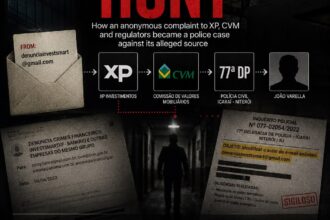
When compliance becomes a facade, public passwords become private weapons, and journalists enter the crosshairs

What is happening to Brazil?
The question may sound too large, almost theatrical. But there are moments when the news stops looking like a sequence of isolated cases and begins to form a pattern. And from a distance, that pattern is disturbing.
A decision by Brazil's Supreme Federal Court, within Operation Compliance Zero, describes, in theory, a structure that allegedly brought together active and retired federal police officers, financial operators, a face-to-face intimidation unit, a technological unit, possible unauthorized access to public systems, profile takedowns, telematic monitoring, and a figure known as "Sicario".
According to the decision, investigators identified two operational arms: "A Turma", allegedly dedicated to threats, in-person intimidation, coercion, clandestine background checks, obtaining confidential data, and unauthorized access to government systems; and "Os Meninos", a technology-oriented group allegedly focused on cyberattacks, telematic intrusions, profile takedowns, and illegal digital monitoring. The decision also records that, at the time of the events, both fronts were allegedly managed by Luiz Phillipi Machado de Moraes Mourao, known as "Sicario" and referred to in some reports also as Felipe Mourao. [1]
This is not an ordinary case.
If confirmed, the investigative hypothesis describes a kind of private outsourcing of coercion: physical intimidation on one side, digital intimidation on the other, and at the center of it all the shadow of money, influence, institutional access, and reputation protected by force.
In this context, the name of the operation sounds almost like involuntary sarcasm: Compliance Zero.
For years, Brazil was sold a market aesthetic wrapped in clean vocabulary: governance, audit, risk, reputation, integrity, due diligence, board, compliance. But the decision places a less elegant possibility on the table: what if, behind certain sophisticated structures, the real machinery is made of institutional passwords, intimidation, hackers, backroom operators, and silence?
To be fair, the Federal Police adopted a rare and necessary posture by investigating its own ranks, including active and retired officers. There is institutional merit in that.
But praise for the Federal Police does not remove the central question. It makes it more urgent:
How far can the Federal Police investigate when part of the problem may be inside, beside, or around it?
The decision mentions people with police ties and describes measures such as preventive detention, suspension from duties, restrictions on contact, prohibition from accessing Federal Police facilities, and transfer to the Federal Penitentiary System, depending on each case. [1]
The most corrosive point is not merely that police officers are mentioned. It is the type of function that, according to the decision, some of these ties may have performed.
The document points, in theory, to the risk that internal Federal Police systems - created for investigation, public security, and protection of the State - may have been used as a private tool for monitoring, leaks, and intimidation. According to the decision, Marilson allegedly sought help from federal police officers to perform improper queries in internal Federal Police systems, with the aim of discovering the contents of an inquiry in which Henrique Moura Vorcaro had allegedly been summoned. [2]
If confirmed, the problem is not merely individual corruption.
It is the conversion of State infrastructure into a clandestine service for private interests. In less bureaucratic language: the public password may have become a private weapon.
A system created to protect citizens may have been used to map targets, watch adversaries, and feed an intimidation machine. When that happens, the State does not fail only by omission. It lends its tools to the underworld.
The decision also mentions suspicion of a local arm in Rio de Janeiro linked to Manoel Mendes Rodrigues, described as an operator of the illegal numbers game. According to the police authority, it would be plausible to infer that this arm was composed of illegal gambling operators, militia members, and police officers. The document describes Manoel as a link between the alleged organization's central command and the local force used for physical intimidation and direct coercion of targets. [3]
That passage is a portrait of deep Brazil: illegal gambling operators, militia members, police officers, businessmen, financial operators, reputation advisers, hackers. People who should inhabit different worlds begin to walk through the same corridor.
And when those worlds meet, democracy does not enter through the front door. It waits outside for a password.
The target was the press
There is a point that makes Operation Compliance Zero even more serious: according to a report from Agencia O Globo republished by Tribuna do Sertao, the Federal Police investigation indicated that a group of hackers linked to Daniel Vorcaro tried to access the cellphone of O Globo columnist Lauro Jardim. The attempt allegedly took place in July 2025. [4]
That changes the temperature of the case.
This is no longer merely about protecting reputation, monitoring adversaries, or shielding financial interests. If the investigation is correct, we are dealing with something more sensitive: a private structure, tied to powerful economic interests, trying to violate the communications of a professional journalist.
When money tries to break into the phone of the person reporting the news, the scandal stops being merely financial.
It becomes democratic.
This is where "Os Meninos" stops being an abstract hacker group. It becomes, in theory, a tool of intimidation against the press. The Supreme Court decision had already described the group as a technological unit allegedly focused on cyberattacks, telematic intrusions, profile takedowns, and illegal digital monitoring. The Lauro Jardim case gives that risk a face and an institutional address: the target was allegedly not just a business enemy or a private adversary, but a nationally known journalist. [1]
And this must be said plainly:
A journalist is not an operational target.
A journalist can be wrong, can be criticized, can be challenged, and can be sued if there is abuse. What can never happen is for a journalist to become the target of hacking, clandestine monitoring, physical intimidation, or private retaliation.
When a private structure allegedly tries to break into a journalist's phone, we are no longer talking about a wounded banker's vanity. We are talking about intimidation against the press, private espionage, and an attempt to turn reporting into an operational target.
When money loses shame, it does not merely want to buy silence.
It wants to break into the phone of whoever can break that silence.
And Rio de Janeiro has seen this movie before.
In 2008, a team from the newspaper O Dia was kidnapped and tortured by militia members in the Batan favela, in Realengo, while investigating the militia's activities in the community. The Human Rights Commission of Brazil's Chamber of Deputies described the episode as torture committed by a militia against journalists and as a grave violation of press freedom. [5]
The Lauro Jardim case is modern in its instrument, but old in its instinct.
Before the hacker, there was captivity. Before the fraudulent link, there were beatings, electric shocks, and suffocation. Yesterday, the press was intimidated with confinement and physical violence. Today, according to the reported investigation, it may be with phones, links, hackers, and digital monitoring.
The method changes.
The message remains: a journalist who investigates parallel power becomes a target. The question, therefore, is not only who tried to access Lauro Jardim's cellphone.
The bigger question is:
How many other journalists, sources, critics, former employees, adversaries, or authorities may have been monitored by similar structures?
How many stories were never born because someone was afraid?
How many sources fell silent because they knew the underworld also knows how to use technology?
At this point, Compliance Zero stops being an investigation into financial backrooms. It touches the nervous system of democracy: the ability of the press to investigate powerful people without becoming the target of a retaliation machine.
Because when a banker can, in theory, activate hackers against a journalist, the problem is no longer only the bank.
It is the country.
The dead man in custody
And there is another point Brazil cannot normalize: Sicario died after being in Federal Police custody.
Agencia Brasil reported that Mourao, arrested in the third phase of Operation Compliance Zero, died in Belo Horizonte on March 6, 2026, after his clinical condition worsened and the brain death protocol was completed. According to the corporation, the investigated man allegedly attempted to take his own life and was revived by the officers responsible for his custody. [6]
Even if the investigation ultimately rules out third-party interference, the fact remains institutionally grave: a person in custody, under the responsibility of the State, cannot simply die without every minute, every camera, every procedure, every officer on duty, and every custody decision being explained with surgical precision.
State custody is not an administrative detail.
It is the total transfer of responsibility for a person's life to public power. When a central suspect dies in that environment, the State should not merely say there was no interference. It must demonstrate, document, audit, and allow external oversight.
Because in custody, there is no such thing as a "private" death.
There is death under public guard.
In Mourao's case, the symbolic gravity is even greater. The Supreme Court decision describes him as manager of the units "A Turma" and "Os Meninos", structures that, according to the investigation, allegedly served the central core of the organization under investigation. [1]
In other words: a peripheral character did not die. Someone described as a sensitive operational piece of a machinery involving in-person intimidation, a hacker unit, illegal monitoring, access to confidential data, and large payments died.
The death of a person in that position does not end only a life. It may also end a source of clarification, a chain of links, an operational memory, and a map of responsibilities.
That is the absurdity.
An investigated man known as "Sicario," described as an operator of a clandestine structure, dies after being in the custody of the institution investigating the case.
Even if the formal cause is explained, the public question remains legitimate:
How did the State allow someone so sensitive, so central, and so relevant to the investigation to reach that outcome while under its guard?
The answer cannot be bureaucratic. A note is not enough. An internal procedure is not enough. A generic conclusion is not enough.
A case of this nature demands external scrutiny, a complete documentary chain, transparency compatible with the law, and an investigation that treats the death not as a footnote to the operation, but as a central event of public interest.
The nebulous obituary
Brazil keeps a kind of nebulous obituary: people dead in custody, people dead in poorly explained approaches, victims of violent crimes, victims of obscure disputes, and cases in which money, power, and fear seem to circulate in the same environment.
This does not mean asserting that all cases are connected.
The greater suspicion is different: the ease with which the country accepts incomplete explanations.
From the case of Felipe Mourao, known as "Sicario," who died after being in Federal Police custody, to victims such as Joao Luiz Silva Seabra Varella and Andre Luiz da Silva Albuquerque, followed in other documentary lines by Nokosphere, the institutional problem is the same: when a death is surrounded by doubt, sensitive context, or incomplete versions, the State's response cannot be silence, a protocol note, or forgetting.
The reference to these victims does not assert an automatic connection between distinct investigations, nor does it suggest any participation by them in crimes, clandestine structures, or Operation Compliance Zero. On the contrary: it recognizes their condition as victims and the need for their deaths to be treated with seriousness, documentation, transparency, and a real possibility of independent scrutiny.
In minimally serious countries, a sensitive death does not become a footnote. It becomes a priority. Especially when it involves State custody, public agents, financial scandals, power disputes, organized violence, or circumstances in which the initial version does not close every door.
Brazil, however, seems to have developed its own technology of forgetting: first the short note, then the opaque procedure, then silence.
When death arrives before truth, silence stops looking like a failure.
It begins to look like a method.
The question is not accusatory. It is institutional:
Were these deaths investigated with the depth the context required?
Were they treated as isolated episodes or as possible signs of broader environments of violence, power, and impunity?
Who had an interest in those silences?
Who benefited from the absence of answers?
The CVM and the time that protects
The CVM, Brazil's securities regulator, should function as the market's sentinel. In this environment, however, it appears as a symbol of another Brazilian problem: the distance between the size of financial scandals and the speed of the regulatory response.
Of course administrative proceedings require technical care, due process, the right to be heard, and caution. But caution cannot become paralysis.
When oversight arrives too late, the fire has already become ruins, the money has already changed address, and the operators have already learned to call smoke "market risk."
Regulatory slowness is not neutral.
It educates the market.
It teaches that punishment may become a cost, that opacity may pay, and that in Brazil time can sometimes work like a kind of provisional acquittal.
The CVM cannot become merely the late notary of disaster. In a market where financial structures move at digital speed, an agency that responds at analog pace ends up functioning, even unintentionally, as part of the operators' comfort.
The delay, even when explained by procedural guarantees, produces a dangerous public effect: the sense that the market runs on fiber optic speed while oversight walks with carbon paper.
The invisible counter of the State
The question imposed by Compliance Zero is not limited to the characters in the decision. It touches a larger disease: the conversion of the public machine into private service.
In other cases followed by Nokosphere, including in Rio de Janeiro, similar suspicions emerge: influence, access, intermediaries, and the possibility that public structures may have been used to resolve private interests.
The technical name may be elegant.
The practice, when confirmed, is less noble: someone sells a path, opens a door, speaks to those they should not, pushes paper, unlocks a system, anticipates information, or operates influence where impersonality should exist.
It is corruption without a receipt.
Favor with varnish.
Influence trafficking disguised as institutional relationship.
Perhaps Brazil does not have only a problem of classic corruption. Perhaps it has something deeper: the informal privatization of the corridors of the State.
The international warning
There is also an international dimension that deserves attention.
Here, the United States does not enter as a target of criticism. On the contrary. It enters as a reference for investigative capacity, financial intelligence, and enforcement. Few jurisdictions have such powerful tools to track money, identify beneficial owners, and block abuse.
When signs emerge of sophisticated structures involving organized crime, financial operators, shell companies, transnational flows of funds, and possible concealment of beneficial owners, it is natural that U.S. authorities would be among the best equipped to identify connections, trace flows, and protect the integrity of their own financial system.
The warning is simple: people linked, even in theory, to criminal or suspicious financial structures may attempt to create or use shell companies in the United States to give lawful appearance to resources of doubtful origin.
This does not assert that such a connection exists in this case.
The point is different: whoever masters the engineering of money laundering can serve any network that needs to transform illicit origin into legitimate appearance.
Therefore, given investigations that mention organized crime, sophisticated financial structures, and possible front operators, it would be prudent for foreign authorities to examine carefully any corporate, financial, or asset links within their territories.
In money laundering, the decisive question is rarely only: where did it come from? It is also: where can it go after it disappears from the radar?
The window
The question, therefore, is not whether Brazil has one more scandal.
The question is whether we still have institutions capable of seeing the whole picture.
Seen up close, each piece may appear manageable: an investigated police officer, a hired hacker, an illegal gambling operator mentioned, a suspicious company, a death with insufficient explanation, a slow regulator, a bank under suspicion, a reputation operator, a journalist in the crosshairs, a sealed proceeding.
Seen from afar, the picture is different.
It is a country where money, coercion, confidential information, and silence seem to circulate through parallel corridors. A country where organized crime no longer necessarily needs to carry a rifle in an alley. It can appear as a contract, a consultancy, software, a holding company, an offshore structure, a badge, or an invitation to a meeting. Operation Compliance Zero may be just an investigation.
Or perhaps it is more than that.
Perhaps it is a window.
And what appears through that window is not pretty.
The Federal Police deserve recognition when they cut into their own flesh. But Brazil needs more than episodic courage. It needs independent investigation, real external oversight, international cooperation, swift financial supervision, and one question repeated until it becomes uncomfortable:
Who still has the independence, courage, and reach to investigate the system when the system begins to investigate itself?
Sources and references
[1] Supreme Federal Court decision, PET 15.978/DF, Operation Compliance Zero, excerpts describing "A Turma," "Os Meninos," "Sicario," and people with police ties.
[2] Supreme Federal Court decision, PET 15.978/DF, excerpt on alleged assistance by federal police officers for improper internal-system queries.
[3] Supreme Federal Court decision, PET 15.978/DF, excerpts on the alleged police-informational arm, e-Pol queries, and the Rio de Janeiro local arm.
[4] Tribuna do Sertao, republishing Agencia O Globo: "Hackers a servico de Vorcaro tentaram invadir celular do colunista Lauro Jardim, aponta PF," May 18, 2026.
[5] Chamber of Deputies Human Rights Commission note on the torture of O Dia journalists by militia members in Batan, Rio de Janeiro, in 2008.
[6] Agencia Brasil, report on the death of Luiz Phillipi Machado de Moraes Mourao, known as "Sicario," after arrest in Operation Compliance Zero, March 2026.
[7] SBT News, report on the death of Juliano Bolson Soares in Rio de Janeiro and the investigation into the origin of the gunshot.
EDITORIAL AND LEGAL NOTE: Nokosphere supports freedom of the press, due process, the presumption of innocence, institutional transparency, as well as independent oversight and reporting in the public interest. The following article addresses matters of significant public relevance, including institutional oversight, press freedom, corruption risks, organized crime, regulatory supervision, digital surveillance, as well as judicial and investigative developments related to Operation Compliance Zero. This publication constitutes journalistic analysis, commentary, and public-interest reporting, and is based on publicly available court documents, media reports, investigative materials, as well as publicly reported allegations and investigative hypotheses. All factual references to individuals, organizations, investigations, alleged conduct, operational structures, institutional relationships, or potentially criminal conduct are based, unless expressly stated otherwise, on judicial decisions, findings by law-enforcement authorities, journalistic reporting, or publicly available source material. Nothing in this publication should be interpreted as asserting that any individual or organization mentioned has committed a criminal offense as an established fact. All persons and organizations referenced are presumed innocent unless and until proven guilty by a final court decision. Terms such as “alleged,” “according to the investigation,” “investigative hypothesis,” “reportedly,” or comparable formulations reflect the existence of ongoing investigations, judicial proceedings, or public reporting, and should be understood as applying throughout the text, even where such qualification is not repeated in every paragraph. Analytical observations, institutional criticism, rhetorical language, and broader commentary regarding democratic institutions, financial systems, power structures, or societal developments constitute protected editorial opinion based on the material referenced in the article. References to possible international financial structures, shell companies, money-laundering mechanisms, intelligence methods, or organized-crime methodologies are discussed in a broader analytical context and do not constitute direct factual allegations against any specific individual or organization absent explicit documentary support. The article is a contributed analytical commentary.