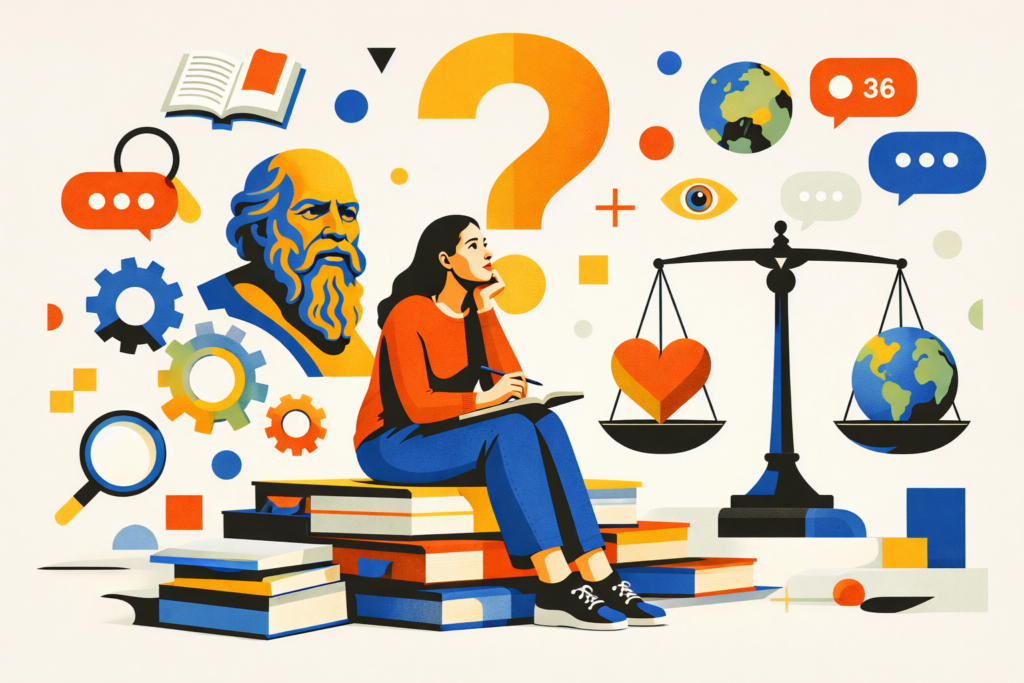
For most people today, philosophy feels disconnected from real life. It belongs in libraries. In footnotes. In thick books that are never fully read…
What few people realize is this: philosophy does not begin only in books. It begins in moments of discomfort. And in moments of happiness. In doubt. In loneliness. In anger and in joy. It begins when something is no longer taken for granted.
Why should I do this?
Who decides what is right?
Is this true or has it simply been repeated often enough to sound true?
What really matters when everything else falls away?
Why do I feel the way I do?
Philosophers matter because they taught people to pause. To look more closely. To take off the (sometimes rose-colored) glasses and face reality.
Before philosophy, explanations were passed down without being questioned. Stories were believed. Power justified itself through tradition, gods, or violence.
Philosophy introduced a disruptive possibility: What if the rules are wrong?
That single, simple question has changed how we live together.
Philosophy shows how to think – not what to think
Most fields of knowledge are presented in factual terms: right or wrong, true or false. Philosophy asks a more fundamental question first: where does this knowledge, or this assumption, come from at all?
Why do we trust certain authorities and not others?
Why is efficiency so often valued more than justice?
Why do we treat certain lives, professions, or countries as expendable?
Philosophy does not deliver answers. What it provides instead are the tools that make answers possible in the first place: logic, clarity, skepticism, and self-reflection.
In a world where information and opinions spreads globally within hours through social media, these tools are survival skills.
Philosophy trains resistance to manipulation
Advertising, media, and algorithms thrive on predictable reactions. Philosophy interrupts that predictability.
It teaches people to recognize:
- emotional shortcuts
- false narratives
- moral language that conceals self-interest
- certainty where none is warranted
A population that only reacts is easy to steer, easy to sell to, easy to divide.
A population that reflects moves more slowly, but is far harder to control.
That is why philosophy has always been uncomfortable for those in power.
Philosophy makes uncertainty bearable – without paralyzing action
Philosophy shows how to live without absolute certainty. It teaches that some questions do not require final answers – and that this is not a failure. It shows how values can collide, and how to navigate those conflicts.
Philosophy accepts that truth is always incomplete, and that human judgment remains flawed.
Rather than collapsing under that realization, it teaches responsibility: acting with humility, gratitude, and an awareness of consequences.
This is not weakness. It is intellectual maturity.
Philosophy protects our humanity in a measurable world
Modern life is dominated by algorithms and numbers. We are categorized by productivity, growth, reach, and performance. Philosophy asks about what cannot be measured and about what matters precisely because it cannot be measured.
Dignity.
Responsibility.
Meaning.
Freedom.
Without philosophical reflection, these concepts become empty slogans. With it, they become standards: debated, defended, and refined over time.
A society that no longer asks why it lives will eventually confuse movement with progress.
Philosophy is not abstract. It is personal
Every serious life decision is philosophical, whether we call it that or not:
What do I owe others?
What kind of person do I want to be?
What kind of person can I be, and why?
What am I willing to sacrifice?
Where do I draw my line?
Ignoring these questions does not make them disappear. Unexamined questions are always answered unconsciously: through habit, fear, or imitation.
Philosophy offers something rare: a conscious relationship with one’s own values.
Why philosophers still matter
Not because they were perfect.
Not because they agreed with one another.
Not because they solved everything.
They mattered because they insisted that thinking is everyone’s responsibility.
In times of crisis, philosophy prevents panic.
In times of certainty, it prevents arrogance.
In times of speed, it demands reflection.
And in a world increasingly optimized for reaction, and clicks, philosophy remains one of the few practices grounded in reason.
That makes it essential.