For Plato, thinking began where the visible world ends.
Born around 427 BCE in Athens, Plato grew up during a time of political change. Athenian democracy was already declining, and power struggles and internal tensions shaped public life. One event, however, stood out above all others and shaped Plato’s thinking for the rest of his life: the execution of his teacher, Socrates.
Plato was about 28 years old at the time.
For Plato, the trial and execution of Socrates were proof that majority decisions do not necessarily lead to truth or justice. Socrates was convicted of alleged impiety and of corrupting the youth, charges that, in a politically unsettled city, also reflected fear of critical thought itself.
This experience deeply shaped Plato’s lasting skepticism toward the visible and immediately apparent world.
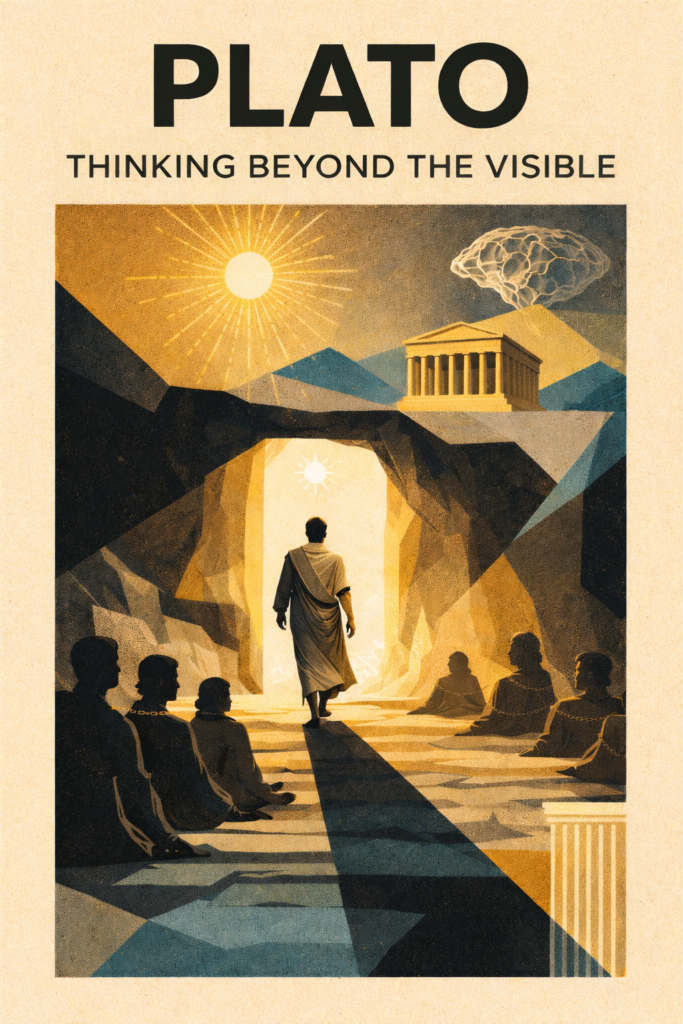
Plato believed that everyday reality is only an imperfect surface. Beneath it, he argued, lies a deeper order: the world of ideas, the Good, the Just, the True, which are timeless and independent of human opinion. This contrast is captured in his famous Allegory of the Cave, where people mistake shadows for reality and only a few manage to see the truth behind appearances.
For Plato, knowledge was not the accumulation of facts but a turning away from illusion. He expressed this through dialogues rather than fixed doctrines, showing that truth emerges through questioning and shared thinking. This approach also shaped his political thought. In The Republic, Plato presented a thought experiment about justice, arguing that political power should belong to those able to distinguish appearance from truth, the philosopher-kings.
He viewed democracy with skepticism – out of concern. He worried about what happens when freedom is no longer guided by orientation or measure. When every opinion carries equal weight, knowledge can lose its authority. Decisions may then be driven less by understanding than by emotion, volume, or short-term moods.
In such conditions, Plato observed, it is often not those who understand most who are heard, but those who persuade most effectively, those who speak loudest, simplify best, or have the greatest attention. Rhetorical skill can obscure truth, and popularity can replace competence. The risk, then as now, is that complex issues are reduced to slogans and political debate becomes reactive rather than reflective.
For Plato, political stability was possible only when reason played the guiding role. A just order must be oriented toward knowledge, not toward constantly shifting majorities. It requires education, restraint, and the ability to distinguish between appearance and reality. Without this inner order, he believed, even the freest form of government could become unstable and gradually undermine itself.
Around 387 BCE, Plato founded one of the earliest philosophical schools in Europe. The Academy was established in a grove outside the city walls of Athens, near the sanctuary of the hero Akademos, from whom it took its name.
Perhaps this is why Plato remains both fascinating and demanding today. The soul, he believed, already carries knowledge within itself and is reminded of it through philosophical questioning. Knowledge is therefore not an external process, but an inner one, a gradual clarification. This is why mathematics played a central role in his Academy: it trained the mind to think abstractly, beyond the deceptions of the senses.
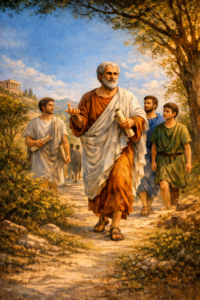
The Academy was not a school in the modern sense, with fixed classes or enrollment numbers. It was an open philosophical circle. At times, several dozen students studied there simultaneously, including thinkers from across the Greek world.
Among the most well-known was Aristotle, who remained a member of the Academy for nearly twenty years.
Plato called for patience in a world of rapid impressions, for reason amid competing opinions, and for the insight that not everything visible is essential. His philosophy invites us to look beyond the obvious and to expect more from thinking than immediate reaction.
Plato offered no easy answers. He placed high demands on knowledge, education, and responsibility. Truth, for him, was not something one possesses, but something one approaches, through thinking, doubt, and discipline.
In a time when what matters most is often what is seen rather than what endures, this demand feels strikingly contemporary: thinking not merely as a response to what confronts us, but as a conscious search for what genuinely has lasting value.
Sources
- Stanford Encyclopedia of Philosophy (SEP), Plato:
https://plato.stanford.edu/entries/plato/ - SEP, Socrates:
https://plato.stanford.edu/entries/socrates/ - SEP, Plato (chronology inferred):
https://plato.stanford.edu/entries/plato/ - SEP, Plato’s Political Philosophy:
https://plato.stanford.edu/entries/plato-ethics-politics/ - Plato, Apology:
http://classics.mit.edu/Plato/apology.html - SEP, Plato – Metaphysics & Epistemology:
https://plato.stanford.edu/entries/plato-metaphysics/ - Plato, Republic, Book VII (Allegory of the Cave):
http://classics.mit.edu/Plato/republic.8.vii.html - SEP, Plato’s Epistemology:
https://plato.stanford.edu/entries/plato-epistemology/ - SEP, Plato’s Dialogues:
https://plato.stanford.edu/entries/plato/#DialChar - Plato, Republic, Books V–VII:
http://classics.mit.edu/Plato/republic.html - Plato, Republic, Book VIII:
http://classics.mit.edu/Plato/republic.9.viii.html - Plato, Gorgias:
http://classics.mit.edu/Plato/gorgias.html - SEP, Plato on Rhetoric:
https://plato.stanford.edu/entries/plato-rhetoric/ - SEP, Plato’s Ethics and Politics:
https://plato.stanford.edu/entries/plato-ethics-politics/ - Plato, Republic, Book VIII–IX:
http://classics.mit.edu/Plato/republic.html - SEP, Plato – The Academy:
https://plato.stanford.edu/entries/plato/#Acad - Encyclopaedia Britannica, Academy (Athens):
https://www.britannica.com/topic/Academy-ancient-school-Athens - Plato, Meno; Phaedo:
http://classics.mit.edu/Plato/meno.html - SEP, Aristotle:
https://plato.stanford.edu/entries/aristotle/