Rio de Janeiro.
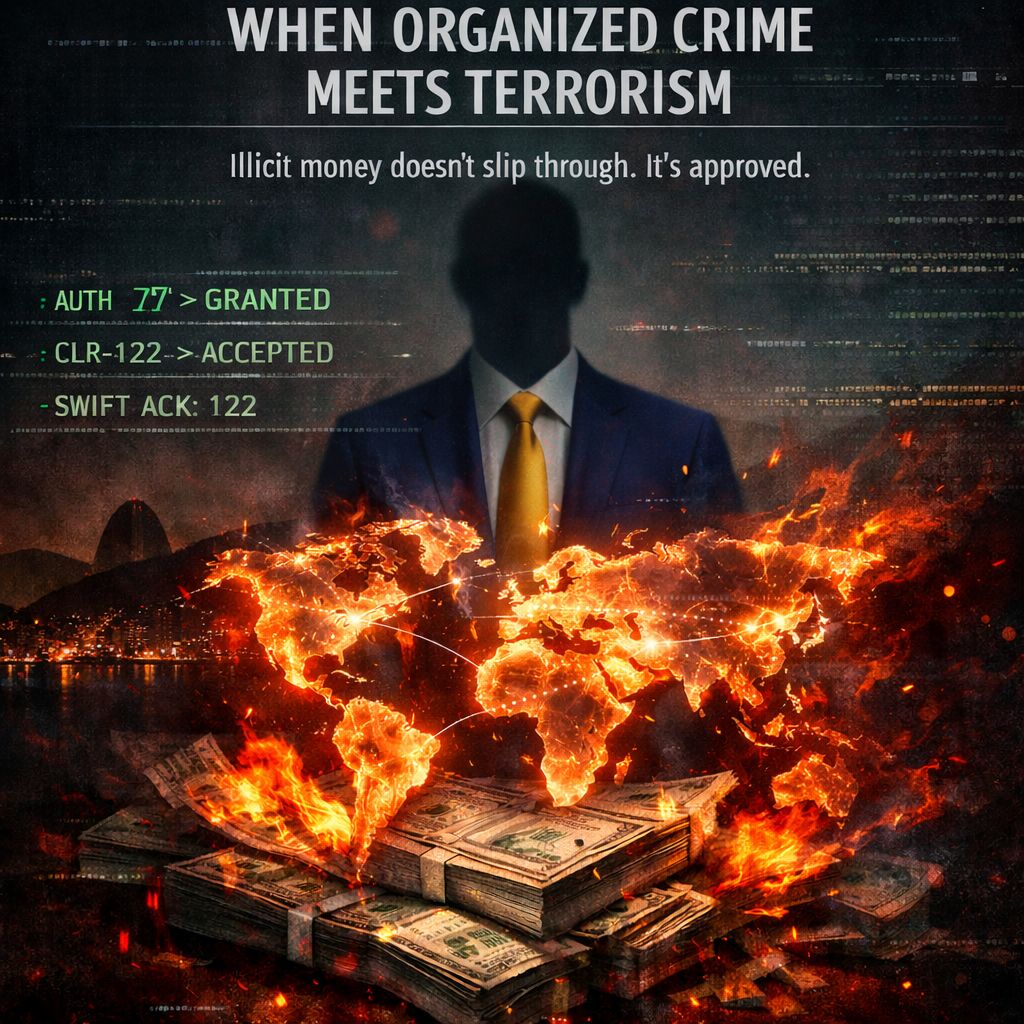
Investigations conducted by Brazilian and international authorities indicate that organized crime in Brazil has expanded its connections beyond national borders, using sophisticated financial structures that, in some cases, overlap with routes traditionally associated with the financing of terrorist organizations. At the center of these operations is money laundering, with Rio de Janeiro occupying a strategic role as a logistical, financial, and port hub.
Convergence of illicit interests
Public security and financial intelligence experts explain that, although Brazilian organized crime and terrorist groups have distinct motivations, the methods used to conceal funds are similar – and, at times, shared.
This does not necessarily involve direct ideological or operational links, but rather the use of common financial infrastructures, exploited by different illicit actors.
“Money laundering is a parallel industry. Whoever masters this technique provides services to any illegal actor who can pay,” says an analyst interviewed on condition of anonymity, as he works for a sensitive state agency.
According to reports from the Financial Activities Control Council (COAF), suspicious operations involving shell companies, fictitious NGOs, informal exchange houses, cryptoassets, and under invoiced foreign trade have been detected with increasing frequency.
The role of Rio de Janeiro
Rio brings together characteristics that make it attractive for this type of activity:
- Historical presence of structured criminal factions
- Ports and airports with intense international flow
- A real estate sector vulnerable to capital laundering
- A significant informal economy
- Proximity to strategic maritime and air routes
Authorities point out that the state functions, in some cases, as a financial transit point, where funds are “cleaned” before being sent to other countries.
The money changer: an invisible link between factions and international networks
At the center of the money laundering machinery is the figure of the money changer, a clandestine financial operator specialized in moving large volumes of resources outside the formal banking system. He acts as a global intermediary, connecting Brazilian criminal factions, international intermediaries, and, in some cases, foreign networks under investigation for terrorist financing.
The most common mechanism involves:
- Receipt of cash in Brazil
- Conversion into foreign credits via shell companies or parallel systems
- Use of simulated contracts and “straw men” to conceal final beneficiaries
- Fraudulent foreign trade operations
- Increasing use of cryptoassets
“The money changer does not ask who the money belongs to; he asks how much it is and what the risk is,” says a federal police chief.
The search for the “entry door” into the SWIFT system
For experts, one of the main objectives of criminal networks is to convert illicit resources into money formally recognized by the international financial system, which requires inserting these values into the SWIFT code, essential for global bank transfers.
As long as the money remains outside this system, its use is limited. The core effort of laundering is to make resources “bankable” and, frequently, to direct them to the United States, chosen for its financial stability, the strength of the dollar, and the depth of its market.
The United States as a strategic destination
The path to the U.S. involves:
- Shell companies and complex legal structures
- “Straw men” appearing as account holders or company partners
- Investments in real estate, funds, and corporate equity
Financial triangulation, fragmented across multiple jurisdictions, makes it difficult to trace the origin of resources and creates an appearance of legality. The money changer is the architect of this machinery, ensuring that illicit money becomes acceptable in the international market.
Fragile oversight of the Brazilian system
Although Brazil has modern laws and specialized agencies, practical enforcement faces limitations:
- Technological gaps in monitoring systems
- Complexity of financial structures, hindering identification of the ultimate beneficial owner
- Legal fragmentation, with gaps in the control of cryptocurrencies and international transfers
- Shortage of specialized human resources
In Rio de Janeiro, where criminal factions maintain strong territorial presence, these weaknesses make it possible for money changers to transform dirty money into legal assets, circulating through the financial system and reaching markets such as the United States.
Rio de Janeiro militias: paramilitaries who control money and territory
In addition to drug trafficking, another actor exerts strong influence: militias, which in practice function as organized paramilitary groups.
- Initially formed by police officers or former police officers, these militias control entire neighborhoods, imposing rules and charging fees from residents and businesses.
- They operate in the illegal exploitation of essential services such as alternative transportation, gas, water, private security, and internet concessions.
- In addition to direct revenue collection, many militias also become financial intermediaries, moving money illicitly, including abroad, through money changers and straw men.
“What we see is a paramilitary structure that appropriates territory, extorts resources, and connects local crime with international financial flows,” explains a public security researcher.
Global risks and warning to the United States
The entry of Brazilian illicit resources into the United States is not merely a local issue but represents a threat to the global financial system:
- Market distortion: illicit money can inflate prices and create unfair competition
- Regulatory and reputational risk: banks that receive resources of obscure origin face severe sanctions
- Indirect financing of illegal activities: laundered resources may be reinvested in high risk sectors or linked to terrorist networks
Experts warn that U.S. authorities should scrutinize financial crimes occurring in Brazil more rigorously as a preventive measure against the financing of international terrorist activities. More intense oversight and direct cooperation between regulators and intelligence agencies could significantly reduce the risk that money originating from local crimes is exploited by terrorist organizations abroad.
Conclusion: a global challenge
The panorama reveals that, as long as money changers exist and the Brazilian oversight system remains vulnerable, the international flow of illicit money will continue, connecting local organized crime, foreign networks, and, in some cases, terrorist organizations. Authorities stress that combating this requires international cooperation, financial intelligence, and corporate transparency – challenges that are still far from being fully met.
Editor’s Note
This article examines structural overlaps in money-laundering methods used by different illicit actors. References to terrorist financing relate to shared financial infrastructures and laundering routes, not to operational or organizational alliances between Brazilian criminal groups and terrorist organizations. All assessments are based on investigative reporting, expert analysis, and publicly available intelligence findings.