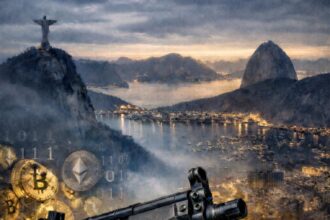
In Rio de Janeiro, organized criminal groups commonly known as militias have reportedly expanded their activities beyond territorial control. According to public investigations and official documents, these organizations may move millions of reais through allegedly legal businesses and financial intermediaries, using shell companies and complex financial operations to conceal the origin of funds. Independent reports – such as those by the Global Initiative Against Transnational Organized Crime (2024) – describe how illicit proceeds allegedly circulate through formal economic channels, masking their illegal nature.
A joint operation by the Civil Police of Rio de Janeiro and the Public Prosecutor’s Office (MPRJ), for instance, claimed that companies suspected of being linked to known criminal groups handled significant sums between 2017 and 2023. These findings are subject to ongoing judicial review. Brazil has a robust Anti-Money Laundering (AML) and Counter-Terrorism Financing (CTF) framework aligned with the Financial Action Task Force (FATF) standards.
Nonetheless, analysts have raised concerns that partial compliance failures in certain financial intermediaries, fintechs, and digital banks could facilitate the entry of illicit resources into the formal economy. No judicial decision has confirmed direct institutional involvement; however, experts point to systemic vulnerabilities that criminal networks may exploit. Furthermore, public and academic analyses suggest that organized crime groups have diversified their assets – reportedly investing in fuel distribution, construction, real estate, and private security – activities that give the appearance of legality to illicit capital. Such hypotheses remain under investigation by competent authorities. While there is currently no judicially established evidence proving a direct connection between Brazilian militias and international terrorist organizations, public sources mention possible overlaps through cryptocurrency transactions, parallel exchange markets, and digital finance ecosystems.
These hypotheses are speculative and do not constitute verified or judicially confirmed facts. Security experts caution that the infiltration of illicit capital into the global financial system — whether through traditional or digital platforms – represents a potential risk to both economic stability and national security. This assessment is shared by several analysts cited in the Global Initiative Against Transnational Organized Crime (2024) report.

Sources (Publicly Available, checked on October 24, 2025)
- Metropoles – Zinho surrenders to federal police
- Federal Police – PF and MPRJ investigate organized crime in Rio
- MPRJ – Official announcement on Rio militia investigation
- Metropoles – Background on Zinho’s arrest
- CNN Brasil – PCC laundered R$6 billion using fintechs
- Agência Brasil – R$46 billion laundered through fintechs
- Receita Federal – Operation Carbono Oculto
- Reuters – Brazil raids organized crime in fuel sector
- Folha de S.Paulo – REAG shares fall after PF operation
- Associated Press – PCC and fuel fraud investigation
- Gazeta do Povo – Organized crime profits more from fuel than cocaine
- Agência Brasil – Government blocks R$1.2 billion in assets
- Agência Brasil – Operation blocks R$1.2B from PCC companies
- Ministry of Justice – Bill to increase penalties for criminal organizations
- Agência Brasil – Government presents tougher organized crime law
- Público (Portugal) – PCC infiltration and laundering operations
- G1 Globo – Militias control over half of Rio’s territory
- Human Rights Watch – Brazil country report
- UOL – Police list leaders of Rio militias
- CNN Brasil – Organized crime moved R$70 billion
- Metropoles – PCC used police officers and fintechs to launder money
- Folha de S.Paulo – Digital bank 2GO suspended for money laundering
- Agência Brasil – Government prepares new anti-terrorism law
- O Globo – Government aims to classify militia crimes as terrorism
- Global Initiative – PCC expansion between Portugal and Brazil
Legal Disclaimer
This article is journalistic and educational in nature. It is based on publicly accessible documents, media reports, and expert commentary. It does not allege, affirm, or imply criminal responsibility for any specific person or institution.
All references to organizations or individuals are made in the public interest and based on sources available at the time of publication. The publisher, Nokosphere, and its editorial team do not issue judicial conclusions and do not substitute official investigations.
The content complies with Article 220 of the Brazilian Constitution, the EU Charter of Fundamental Rights (Art. 11), Germany’s Press Code, and the U.S. First Amendment, while respecting all applicable defamation and data-protection laws. Any person or entity mentioned retains the right of reply and correction (as per Article 5 V of the Brazilian Constitution, Section 56 of the German Interstate Media Treaty, and international journalistic ethics).