

Judicial filings, regulatory scrutiny, and international expansion raise transparency and governance concerns around fast-growing financial network
In institutional communications released throughout 2024, the financial advisory firm Invest Smart Agentes Autônomos de Investimentos Ltda. and related entities stated that it held approximately R$ 24 billion under custody on August 16, 2024, and R$ 25 billion on October 14 of the same year, values attributed to the assets of clients linked to its investment intermediation operations.
What did a court enforcement action reveal about available liquidity?
On September 6, 2024, a decision rendered in case no. 0900399-93.2023.8.19.0001, pending before the 5th Business Court of the Capital District of the Rio de Janeiro State Court of Justice, ordered the execution of an online attachment of the company’s accounts to satisfy an enforcement in the amount of R$ 350,197.11.
The result of the consultation with the judicial banking system located R$ 81,181.32 in the accounts reached at the time of the order. The enforcement was subsequently closed for procedural reasons, with the release of the amount to the company, but the episode made public the difference between the disclosed financial scale and the operational liquidity visible in the structure’s own accounts.
How are “assets under custody” interpreted in financial governance?
Financial governance specialists observe that values disclosed as “under custody” refer to clients’ assets held in third-party financial institutions and not to the advisory firms’ own cash. Even so, the judicial exposure of reduced liquidity in structures that communicate large-scale assets tends to generate reputational questions regarding perceived financial robustness, institutional transparency, and consistency between market narrative and operational structure.
What regulatory history exists at the Brazilian securities authority (CVM)?
Regulatory history and critical points in the CVM proceeding
The structure linked to the group and its managers appears in Administrative Proceeding CVM no. 19957.001954/2020-11, initiated to investigate irregularities in the Brazilian capital market.
Technical documents from the authority mention, within the scope of the procedure, the existence of investor losses arising from an alleged fraudulent operation in the capital market, in addition to references to the possibility of misleading investors and the use of structures that could generate a perception of solidity superior to operational reality.
Among the critical points analyzed in the administrative proceeding are:
• mention of investors who allegedly suffered relevant financial losses;
• discussion regarding communication and structure that could convey an appearance of security or robustness above actual operational capacity;
• analysis of the performance of agents and structures linked to the group in the attraction and intermediation of investments;
• assessment of possible need for reimbursement to investors;
• maintenance of a technical classification considered serious by the authority’s specialized area.
The proceeding mentions by name:
• Samyr Teixeira Rodrigues Castro
• Invest Smart Assessor de Investimento Ltda.
• other agents linked to the analyzed structure
In market governance and compliance analyzes, regulatory procedures that include mention of investor losses and alleged fraudulent operation tend to significantly increase the level of institutional and reputational attention, especially when associated with expanding structures.
Are there indications of international expansion?
International expansion and entry into the North American market
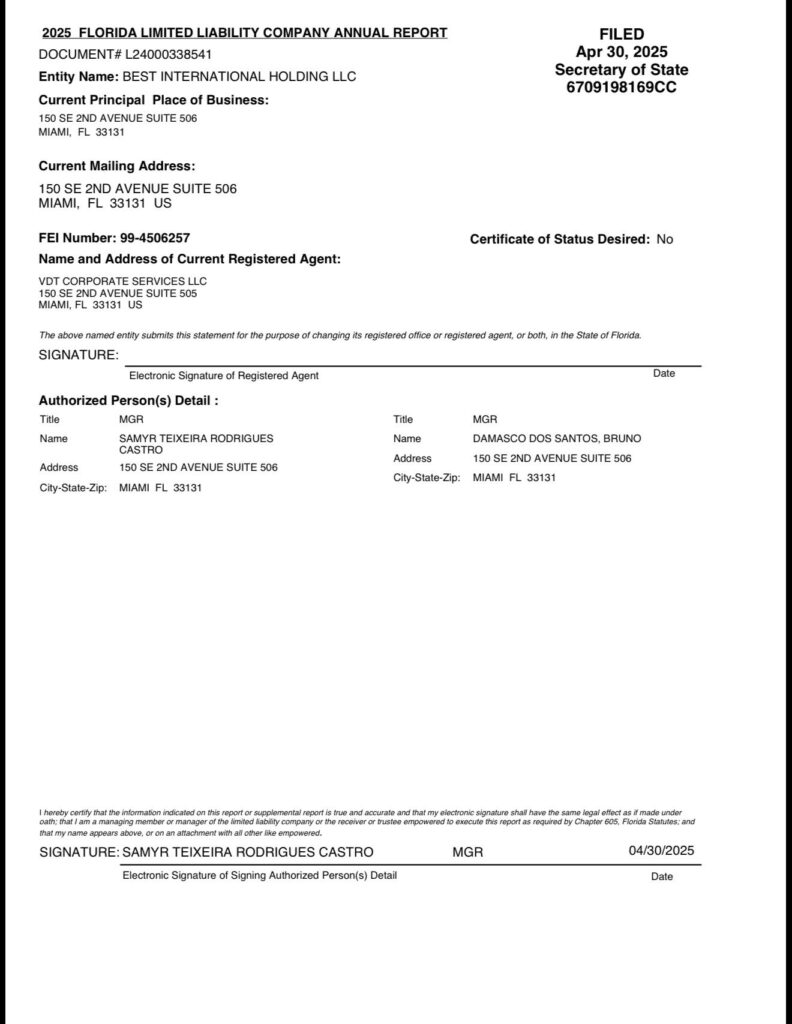
Public corporate records from the State of Florida indicate the existence of the company Best International Holding LLC, based in Miami, with an equity participation of Samyr Teixeira Rodrigues Castro, identified in corporate documents as managing member of the structure.
The activity and public expression of interest in expanding operations in the United States place the group within a regulatory environment characterized by high standards of transparency and reputational verification.
In mature markets such as the United States and the United Kingdom, the entry of foreign financial structures with a sensitive regulatory history tends to generate:
• increased regulatory and banking scrutiny;
• reinforced due diligence processes;
• verification of reputational and regulatory history;
• continuous monitoring by financial institutions and market counterparties.
The coexistence between international expansion plans and regulatory questions in jurisdictions of origin usually leads to more rigorous verification by financial institutions, partners and supervisory authorities.
Do investigative or police records mention related individuals?
Investigative records and still-sensitive episodes
Police occurrence documents indicate that names linked to the business group appeared in investigative records in the State of Rio de Janeiro, including Occurrence Record no. 077-02054/2022, conducted by the 77th Police Station of Niterói.
The record forms part of a broader set of controversies involving persons associated with the business environment surrounding the group. Episodes of a violent nature involving André Luiz da Motta e Albuquerque, João Luiz Silva Seabra Varella, and Juliano Bolson Soares remain surrounded by questions regarding their circumstances and are the subject of public and institutional attention.
The coexistence of judicial disputes, regulatory procedures, and serious events still under question increases the level of reputational and institutional scrutiny over business structures linked to the context.
How can the documented elements be read from an institutional risk perspective?
- Reputational risk triangle: institutional reading
The combined reading of the documented elements forms, under a technical perspective of institutional analysis, a reputational risk triangle composed of:
- Regulatory risk
associated with the history of administrative proceedings involving investor losses and alleged fraudulent operation in the capital market;
- Liquidity perception risk
resulting from the judicial exposure of reduced operational liquidity in relation to the public narrative of billion-scale financial capacity; - Communication risk
related to possible asymmetry between institutional communication of robustness and external perception of effective financial structure.
This set does not in itself constitute proven current financial irregularity, but it significantly raises the level of scrutiny by investors, financial institutions, and regulatory authorities.
Why is this considered a matter of public interest?
Public interest alert and need for transparency
The set of judicial documents, regulatory records, and investigative occurrences related to the analyzed business structure exceeds the sphere of private disputes and assumes an unequivocal dimension of public interest.
The convergence between judicially exposed financial discrepancies, sensitive regulatory history, international expansion, and episodes still surrounded by questions positions the case under increased observation by the market and authorities.
In financial environments characterized by significant investor attraction and multi-jurisdictional activity, the preservation of public trust, the protection of testimonies, and institutional transparency become central elements for maintaining the credibility and integrity of the financial system.
Document 1

Document 2

Document 3
Document 4

Editorial Note
This publication is based on publicly available documents as well as on materials provided to Nokosphere and reviewed by the editorial team.
The text summarizes and reproduces information contained in these sources for informational purposes. The content reflects the existence and documented status of the referenced proceedings, records, and filings at the time of editorial review.
The information presented does not constitute an allegation, accusation, or determination of wrongdoing, liability, or misconduct by any individual or entity. References to administrative, judicial, or investigative proceedings do not imply any finding of fault or legal responsibility, unless such a finding is expressly stated in the original source.
Values described as “assets under custody” refer, according to standard industry terminology, to client assets held with third-party financial institutions and do not represent the advisory firm’s own liquid funds.
This material is provided solely in the interest of factual documentation and public information. Where possible, source references or documents are made available to allow independent review.
No conclusions beyond the content of the cited sources are intended or implied.