When you imagine yourself thinking, where do you see yourself? Probably sitting still, in a quiet room, a café, or on a park bench, quietly lost in thought. That image is familiar to many of us. Aristotle, however, imagined thinking differently. He did not believe that thought emerges best in silence. He believed it arises through movement.
Born in 384 BCE in the small town of Stagira, Aristotle grew up in a world shaped more by observation than abstraction. His father served as a physician at the Macedonian court, and from an early age Aristotle learned a lesson that would quietly shape his entire body of work: understanding begins by carefully observing how things actually behave.
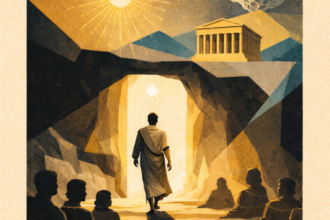
When Aristotle later arrived in Athens to study under Plato, he entered a world dominated by ideals. For Plato, truth existed beyond the material world, in perfect forms untouched by the disorder of everyday life. Aristotle listened closely and then chose a different path. This decision became one of his most defining breaks from his teacher.
Aristotle argued that knowledge begins with observation: with animals, with people, with language, with stories. Rather than asking what things ought to be in theory, he asked what they are in practice. This approach led him to something radical for his time: the systematic study of nature.
He dissected animals, compared organs, and classified living beings according to shared characteristics. His biological writings were unusually methodical for their era, grounded in observation, comparison, and an early form of classification. They were not myth or speculation, but precursors to scientific inquiry centuries before modern methods were formalized.
The same earthbound thinking shaped Aristotle’s work on logic.
He was the first to describe structured reasoning in a formal way, introducing the syllogism, arguments built from premises that lead logically to conclusions. While this may sound technical, its impact was immense. Aristotle provided future generations with a tool to distinguish sound reasoning from mere rhetoric. For nearly two thousand years, his logic formed the backbone of scientific, philosophical, and legal argumentation.
Yet Aristotle never believed that logic alone was sufficient for living well.
In his ethical writings, most notably the Nicomachean Ethics, he rejected the idea that virtue consists of strict rules or moral perfection. Instead, he articulated one of his most enduring insights: the idea of the mean. Courage, he argued, lies between recklessness and fear. Generosity lies between excess and stinginess. Virtue is not an extreme, but a judgment refined through practice and adapted to circumstance.
Ethics, for Aristotle, was not a formula. It was a skill.
This conviction, that human life resists rigid rules, also shaped his understanding of happiness. Happiness, or eudaimonia, was neither pleasure nor comfort. It was the experience of living with purpose: using one’s capacities well and being meaningfully engaged with the world. A good life was active, not passive.
Aristotle extended this way of thinking to art and storytelling. In Poetics, he asked why certain stories move us and why tragedy, in particular, can feel meaningful rather than merely depressing. His answer introduced another lasting insight: that narratives have structure: beginnings, middles, and ends, and that emotional release, or catharsis, plays a role in how humans process experience. Modern screenwriting manuals still echo these ideas.
Even politics, for Aristotle, began with observation rather than ideology. In his work Politics, he did not attempt to design an ideal state. Instead, he examined real communities. He collected and compared constitutions, analyzed power structures, and asked under what conditions political order remains stable – or collapses. Politics, for Aristotle, was not a matter of abstract principles but a practical science closely tied to human behavior.
He distinguished between forms of government that serve the common good and those that primarily benefit the few. The formal structure of a regime mattered less than its function. A system could be legally correct and still unjust if it drifted away from the common interest. This distinction between sound order and its distortion remains one of Aristotle’s most lasting political insights.
Central to his political thought was the role of the middle. Extreme poverty and extreme wealth, he argued, both threaten political stability. A strong, broad middle class fosters balance, moderation, and long-term order.
For Aristotle, the state existed not merely to ensure survival or security. Its purpose was higher: to create conditions in which people could live well. Politics and ethics were inseparable. Laws were not designed merely to regulate behavior, but to shape habits, dispositions, and a sense of mutual responsibility.
Aristotle viewed the democracy of his time as a distorted form of popular rule when it allowed the majority to govern in its own interest rather than for the common good. He warned that such systems risk weakening the rule of law and empowering demagogues.
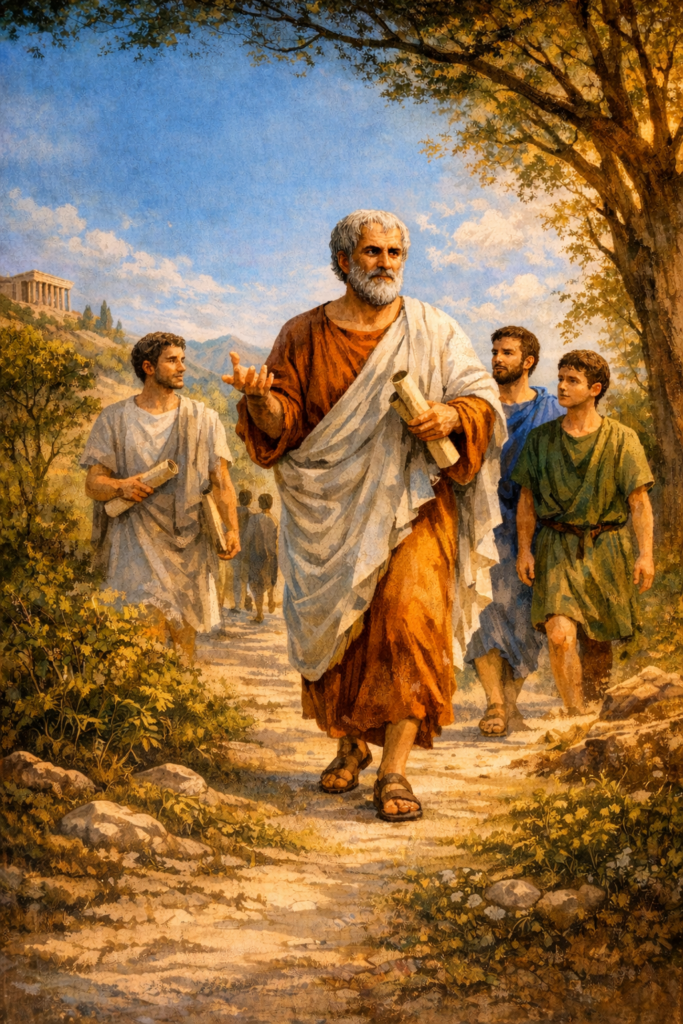
When Aristotle founded his own school, the Lyceum, in Athens in 335 BCE, he put his philosophy into practice. Teaching did not take place behind closed doors or from a fixed lectern. It happened while walking. Students followed him along shaded paths, discussing ethics, science, and society in motion.
Perhaps this is why Aristotle still feels so relevant today.
He did not offer final certainty, but a way of thinking. He accepted complexity. He distinguished between fields that allow precision and those that require judgment. He evaluated political order not by its name but by its effects and distrusted systems that drifted away from the common good.
His thinking reminds us that stability, justice, and understanding do not emerge from absolutes, but from balance, careful observation, and a willingness to revise.
Thinking, for Aristotle, was a continuous practice: sober, context-sensitive, and always in motion.