Denmark has never been a large country. It has no dramatic mountain ranges, no vast distances, no overwhelming sense of scale. And yet, its history reaches far beyond its borders. Long before Denmark became associated with bicycles, calm cities, and candlelit windows, it was known for something else entirely.
The Vikings
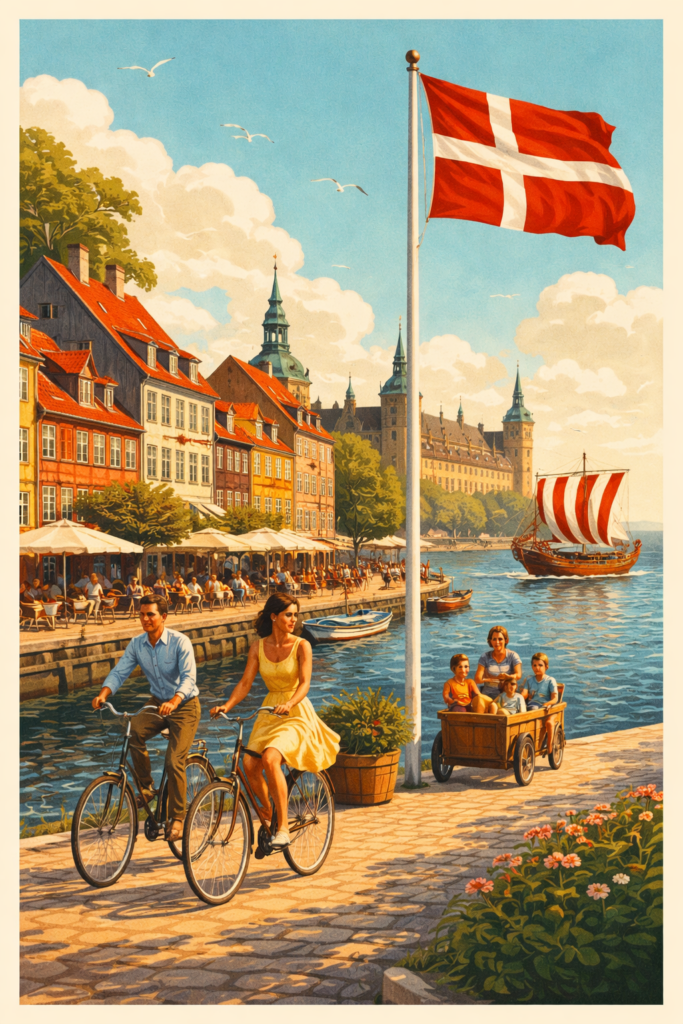
From roughly the eighth to the eleventh century, Danish Vikings sailed outward across seas and rivers, reaching the British Isles, parts of France, and beyond. They traded, settled, and explored. Denmark’s influence during this period was not built on size, but on movement. Ships, not walls, defined its power. That outward curiosity, paired with practical seamanship, still echoes faintly in the country’s character.
Over time, Denmark’s territorial reach expanded and contracted. At various points, the Danish crown ruled over large parts of Scandinavia, including Norway, before gradually losing territory and influence. By the nineteenth century, Denmark had turned away from expansion and toward internal balance, shaping the society it is known for today.
Today, Denmark is physically modest. The country covers just over 43,000 square kilometers, making it smaller than many European regions. Its population stands at around 5.9 million people. These numbers matter, because they shape daily life. Distances are short. Nature is close. Administration is manageable. Society functions on a human scale.
One symbol links past and present in an unusually visible way: the Danish flag.
The Dannebrog appears everywhere. It is raised not only on official buildings, but in front of homes, along streets, at kindergartens, and on birthday cakes. In Denmark, the flag does not signal political emotion. It signals occasion. A birthday, a graduation, a family gathering, the simple act of marking a moment as special.
Everyday life follows a steady rhythm. Mornings begin early. Cities wake quietly, with people cycling to work, children riding in cargo bikes, and cafés opening without urgency. Public transport runs reliably. Offices tend to empty earlier than in many other countries. Evenings are clearly reserved for private life.
Danish homes are practical rather than showy. Space is used carefully. Light plays a central role, especially during long winters. Candles are common, not as decoration, but as a way of softening darkness. Meals are simple and seasonal. Conversation is calm. Silence is comfortable.
This way of living helps explain why Danes consistently rank among the world’s happiest populations. The happiness measured in these studies is not excitement or constant cheerfulness. It is stability. People trust institutions. Rules are predictable. Social safety nets are strong. Equality is visible in everyday interactions, and extremes are rare.
The concept of hygge fits naturally into this environment. It describes moments of ease rather than indulgence: warmth while it is cold outside, shared food without ceremony, time spent together without pressure. Hygge is not an escape from daily life. It is how daily life is shaped.
Work culture reflects the same values. Efficiency matters, but constant availability does not. Being busy is not admired for its own sake. Time is treated as something to be protected. Success is expected to be quiet.
Denmark today is open, modern, and globally connected, but deeply grounded in its routines. Neighborhoods feel lived in rather than impressive. Nature is never far away. The country functions without urgency, and without much noise.
Perhaps this is why Denmark continues to stand out. Not because it offers perfection, but because it shows how much can be gained from moderation, trust, and consistency. Other countries often look to Denmark for inspiration, studying its systems and policies. Danes themselves rarely make a point of it. They simply live their lives.
And maybe that, more than anything else, is the lesson Denmark offers: that happiness does not always come from having more, but from needing less.